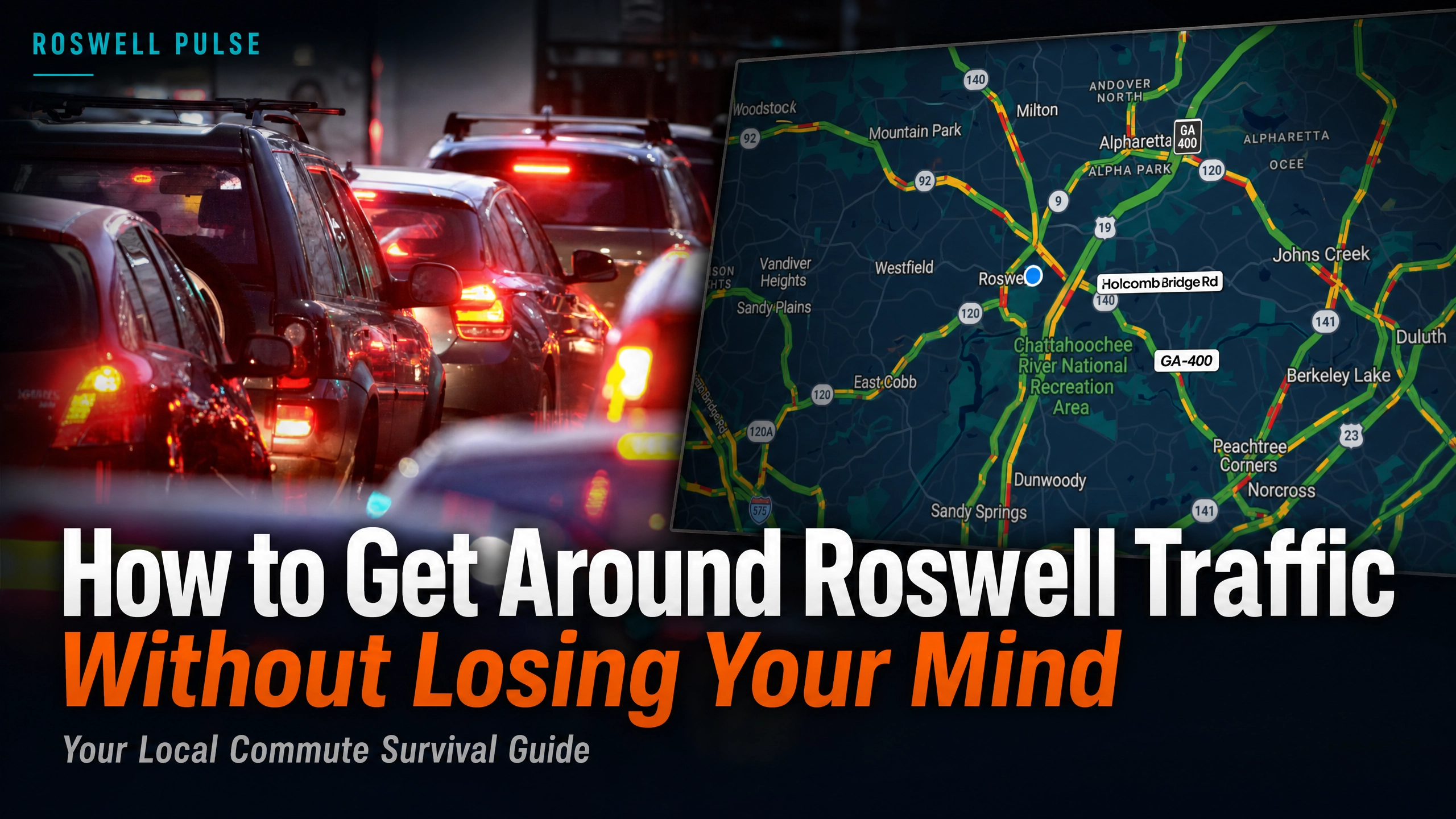

How to Get Around Roswell Without Losing Your Mind
Roswell is a city of nearly 100,000 people sitting at the intersection of three major arterial roads, two state highways, and the southern terminus of GA-400 traffic spilling out toward Holcomb Bridge Road. The result is exactly what you would expect. Getting around Roswell on a Tuesday at 8 a.m. is fundamentally different from getting around Roswell at 11 a.m., and locals who have lived here for any meaningful length of time have built an unspoken mental map of which roads to take when, which intersections to avoid, and which side streets actually save you time. This guide is an attempt to put that mental map down on paper for everyone else.
What follows is a practical, real-world breakdown of the highest traffic corridors in Roswell, the times of day and week to avoid them, and the alternative routes that experienced locals use to stay sane during peak commute windows. We are also going to cover current construction projects that are actively reshaping traffic patterns through 2026, and the apps and tools you should actually be using if you live here. None of this is going to make Roswell traffic disappear. But it will help you avoid the worst of it.
The Quick Hits
Worst AM Rush7:00 a.m. to 9:00 a.m. on Holcomb Bridge Road, GA-400 southbound, and Highway 9 (Alpharetta Street)Worst PM Rush4:30 p.m. to 6:30 p.m. on the same corridors, plus Hwy 92 (Woodstock Road) heading westSweet Spot9:30 a.m. to 3:30 p.m. on weekdays — most Roswell roads flow well during this windowSaturday PatternHeavy 10 a.m. to 1 p.m. around the historic district, farmers market, and Canton StreetActive ConstructionGreen Street downtown closure (through approximately late 2026), Willeo Creek Bridge replacement, various culvert projectsBest ToolWaze for real-time routing, 511GA.org for highway conditions, Google Maps for general planning
I.Understanding Roswell’s Traffic Geometry
Before getting into specific corridors, it helps to understand how traffic actually moves through Roswell. The city is bounded on the south by the Chattahoochee River, which means there are only a handful of bridges getting in and out of town to the south. The historic district sits in the middle of the city along Highway 9, also called Atlanta Street and Alpharetta Street depending on where you are on it. GA-400 cuts through the eastern edge of Roswell with a single major exit at Exit 7 for Holcomb Bridge Road. Holcomb Bridge Road itself is the main east-west arterial running across the south part of the city. Highway 92, also called Woodstock Road, is the main east-west arterial running across the north part of the city.
That geometry creates predictable bottlenecks. Anywhere two of those major roads cross, you get traffic. Anywhere a major road crosses the river, you get traffic. Anywhere GA-400 spills its rush hour load onto Holcomb Bridge, you get traffic. Most of the worst Roswell congestion is in roughly six or seven specific spots, and once you understand where those are, you can plan around them.
II.The High Traffic Corridors
Here are the corridors and intersections where you are most likely to lose time during peak hours, broken down by what causes the congestion and when to expect it.
Holcomb Bridge Road (Highway 140) and GA-400 Exit 7
East to west across south Roswell · Heaviest traffic corridor in the city
Holcomb Bridge Road at GA-400 Exit 7 is the busiest single intersection in Roswell. Holcomb Bridge carries the bulk of east-west commute traffic across the southern half of the city, and Exit 7 is one of the few major exits between the I-285 perimeter and Alpharetta. Add in the commercial density along Holcomb Bridge with its strip centers, restaurants, and the major retail corridor west of GA-400, and you have the perfect storm of cars trying to enter, exit, and cross all at the same intersection.
Heading east on Holcomb Bridge in the morning, the bottleneck stacks up at the GA-400 ramps as drivers wait to merge onto 400 southbound toward Atlanta. Heading west in the evening, the bottleneck reverses as 400 traffic exits and floods the Holcomb Bridge corridor toward neighborhoods on the west side. The stretch of Holcomb Bridge from the GA-400 interchange west to Alpharetta Highway is reliably backed up during both rush hours.
When to avoidWeekdays 7:00 a.m. to 9:00 a.m. eastbound, 4:30 p.m. to 6:30 p.m. westbound. Saturday traffic is lighter but still heavy on the commercial stretch from late morning through mid-afternoon.
Highway 9 / Alpharetta Street / Atlanta Street Corridor
North to south through the historic district · The spine of downtown
Highway 9 is the same road that becomes Atlanta Street as it heads south through the historic district and Alpharetta Street as it heads north toward Alpharetta. It is the spine of downtown Roswell and the primary north-south route through the heart of the city. Traffic builds during morning rush as commuters head south toward I-285 and the Sandy Springs / Buckhead employment corridors. It builds again during evening rush in the reverse direction.
The historic district stretch through downtown Roswell is particularly prone to congestion during morning and evening rush because of the high signal density, pedestrian activity, and the simple fact that it is a two lane road carrying suburban commuter volume. The intersection at Atlanta Street and Riverside Road, just north of the Chattahoochee River bridge, is one of the consistent slowdowns.
When to avoidWeekdays 7:00 a.m. to 9:00 a.m. southbound, 4:30 p.m. to 6:30 p.m. northbound. Saturday afternoons during downtown events like Alive in Roswell or major weekend festivals also create predictable backups.
Highway 92 / Woodstock Road
East to west across north Roswell · Connects to Cherokee County
Highway 92, also called Woodstock Road through Roswell, is the main east-west arterial across the north part of the city. It carries a significant volume of commuter traffic between Cherokee County and the GA-400 corridor, plus local traffic to Roswell schools, neighborhoods, and Roswell Area Park. The intersection at Highway 92 and Bowen Road is currently scheduled for GDOT improvement work, which will affect this corridor over the next year or so.
Heading east on Hwy 92 in the morning, expect slowdowns at signals through Roswell as traffic builds toward GA-400. Heading west in the evening, expect the same in reverse, with the bottleneck particularly heavy near Crabapple and as the road approaches Cherokee County. School zones along this corridor add additional slowdowns when school is in session, especially around morning drop-off and afternoon pickup windows.
When to avoid: Weekdays 7:00 a.m. to 9:00 a.m. eastbound and 4:30 p.m. to 6:30 p.m. westbound. School zone hours add slowdowns at certain stretches when school is in session.
GA-400 Through Roswell
North to south through east Roswell · The regional artery
GA-400 is the regional highway that connects North Atlanta suburbs to the I-285 perimeter and into the heart of Atlanta. The Roswell stretch of GA-400 runs from approximately Northridge Road on the south up through Mansell Road on the north, with Exit 7 at Holcomb Bridge Road as the city’s primary access point. Traffic on GA-400 southbound during the morning commute is reliably congested from Exit 9 (Mansell) all the way down through Sandy Springs, with the worst slowdowns typically clustering around the I-285 interchange.
The northbound evening commute is the mirror image, with traffic backing up from I-285 northward through Sandy Springs and into Roswell. Weekend traffic on GA-400 spikes around major shopping destinations and during summer weekends as Atlanta heads to North Georgia mountains and lakes.
When to avoidWeekdays 7:00 a.m. to 9:00 a.m. southbound, 4:30 p.m. to 7:00 p.m. northbound. Friday evenings in summer can extend the northbound rush as far as 8:00 p.m. due to weekend leisure travel.
Crabapple Road and the Crabapple Crossroads
North Roswell into Milton · School and neighborhood traffic
Crabapple Road runs north from Roswell into the Milton/Crabapple area and carries significant school traffic plus commuter overflow from the GA-400 corridor. The intersection of Crabapple Road and Mid-Broadwell, in the heart of the Crabapple historic district, is a consistent slowdown during school drop-off and pickup hours. Crabapple Road is also a popular alternative route for drivers trying to avoid GA-400 congestion, which means it gets its own version of rush hour just from people fleeing the highway.
When to avoid: Weekdays 7:30 a.m. to 8:30 a.m. and 2:45 p.m. to 4:00 p.m. due to school traffic. Adult commuter rush stacks on top of school rush in both directions.
Riverside Road and the Chattahoochee Bridge Crossings
River crossings · Limited bridge capacity
Anywhere a Roswell road crosses the Chattahoochee River, you have a bottleneck because there are only a handful of bridges and they all become single points of failure during peak times. The Atlanta Street bridge at the south end of the historic district carries the bulk of southbound commute traffic into Sandy Springs. Riverside Road, which runs along the north bank of the river, gets pressed into service as an alternate when the Atlanta Street bridge is jammed, and it has its own slowdowns at signals along the way.
Roswell Road, also known as Highway 9 south of the river, is technically Sandy Springs at that point but carries a heavy share of Roswell commuter traffic heading toward I-285. The I-285 and Roswell Road interchange itself is one of the most chronically congested interchanges in metro Atlanta, with GDOT currently studying major redesign options that may eventually include a diverging diamond interchange. Until that gets built, expect the existing interchange to remain a regional bottleneck.
When to avoid: Weekdays 7:00 a.m. to 9:00 a.m. southbound, 4:30 p.m. to 6:30 p.m. northbound. River bridge incidents can cascade across the entire south Roswell road network because there are so few alternative crossings.
III.The Times to Drive (and the Times to Stay Home)
If you have any flexibility about when you drive in Roswell, here is the breakdown of when the roads actually move and when they do not.
The Sweet Spot: 9:30 a.m. to 3:30 p.m. weekdays
This is the magic window. Morning rush has cleared, afternoon rush has not started, and most Roswell roads flow at or near posted speed limits. If you can schedule appointments, errands, lunches, or any trip that involves crossing the city for this midday window, you will save real time. Doctors, dentists, and other appointments are also less crowded during this window for the same reason. Roswell at 11 a.m. on a Tuesday is a different city than Roswell at 8 a.m. on a Tuesday.
The Worst Windows: 7:00 a.m. to 9:00 a.m. and 4:30 p.m. to 6:30 p.m.
These are the windows that actually constrain the city. Most major arterials are at or above their design capacity during these hours. The GA-400 corridor south of Roswell is reliably backed up. Holcomb Bridge Road and Highway 9 carry sustained heavy volume with frequent signal-induced slowdowns. Plan to add 15 to 30 minutes to any cross-city trip during these windows compared to the same trip at noon.
School Zone Hours: 7:30 a.m. to 8:30 a.m. and 2:30 p.m. to 4:00 p.m. on school days
The City of Roswell has approved automated speed detection cameras in select school zones, and these are now active. Speed limits in school zones during posted hours are strictly enforced, and the cameras issue tickets automatically. If your route passes any Roswell school during posted hours, drop to the school zone speed and stay there. Beyond the ticket risk, school zone hours produce real congestion on roads near schools as parents drop off and pick up. Roads like Hardscrabble, Crabapple, Hwy 92, and the side streets around Roswell High and Crabapple Crossing get noticeably slower during these hours.
Saturday Mid-Morning to Mid-Afternoon
Saturdays in Roswell have their own traffic pattern that does not match weekday rush hour. The historic district fills up between 9:00 a.m. and 1:00 p.m. as locals and visitors hit the farmers market, Canton Street, and the historic homes. Holcomb Bridge Road’s commercial stretch gets heavy from late morning through mid-afternoon as people run weekend errands. If you are trying to navigate downtown Roswell on a Saturday, plan to arrive before 9:30 a.m. or after 2:00 p.m. for the smoothest experience.
Sunday Mornings
Sunday morning is one of the most underrated quiet windows in Roswell traffic. Between 7:00 a.m. and roughly 11:00 a.m., most major roads are wide open. If you need to do anything that requires driving across the city without traffic, Sunday morning is your friend. The exception is church traffic on Atlanta Street and around the historic district, which clusters around the major service times.
IV.Active Construction You Need to Know About
Several active construction projects are currently affecting Roswell traffic patterns and will continue to do so through 2026.
Active Through Late 2026Green Street is fully closed from Cherry Way to Alpharetta Street as part of the Green Street Activation Plan, which kicked off May 4, 2026 alongside the new downtown parking deck. The closure runs approximately six months. Use Alpharetta Street, Canton Street, Atlanta Street, or Mimosa Boulevard for downtown circulation during construction. See our Roswell Parking Guide for full details.
Willeo Creek Bridge Replacement
The Willeo Creek Bridge replacement project is ongoing along Willeo Road in the northwest part of Roswell, near the Chattahoochee Nature Center. Expect lane closures, occasional detours, and slower speeds in the project area. Willeo Road traffic is generally lighter than the major arterials, but if your commute uses Willeo Road as a connector between Hardscrabble Road and Roswell Road, plan extra time during active construction phases.
Highway 92 / Woodstock Road and Bowen Road Intersection
GDOT has work planned at the intersection of Highway 92 and Bowen Road to improve traffic flow and safety. Expect intermittent lane closures and detours during active construction. This is the kind of project that can create temporary slowdowns on Hwy 92 in both directions, especially during morning and evening rush.
Various Culvert and Drainage Repairs
The city periodically performs culvert and drainage repairs on residential streets across Roswell. These are typically short duration projects of three to four weeks, but they often involve full street closures during the work. Recent examples have included Pine Grove Road and Norcross Street. Sign up for City of Roswell traffic alerts on their website or follow the City of Roswell Government Facebook page to stay ahead of these.
V.Alternative Routes Locals Actually Use
Here is where the local knowledge actually pays off. These are the alternative routes that experienced Roswell drivers use when the main arterials are jammed.
Avoiding Holcomb Bridge Road During Rush
If you need to cross the southern part of Roswell east-to-west and Holcomb Bridge is jammed, your best bet is to drop south to Riverside Road along the Chattahoochee River. Riverside connects to Roswell Road on the east end and to Azalea Drive and the river park system on the west end. It is a slower posted speed but it does not get the GA-400 spillover that kills Holcomb Bridge during rush hour. The trade-off is that Riverside is not a true through route — it requires you to navigate connector streets at either end.
For local trips between specific Holcomb Bridge destinations, side streets through neighborhoods like Martin’s Landing, Horseshoe Bend, and Willow Springs can shave time off short trips, though these are residential streets and you should drive them as such.
Avoiding the GA-400 Southbound Morning Rush
The classic Roswell move when GA-400 southbound is at a standstill is to take Roswell Road south through Sandy Springs and into the Buckhead corridor instead of fighting the highway. Roswell Road is slower in absolute terms but more predictable, and during peak rush it is sometimes faster end-to-end than 400. The other option is to drop down to Highway 9 / Atlanta Street, which feeds into Roswell Road south of the river anyway. Neither option is fast, but both are typically less stressful than sitting on a stationary 400.
For destinations on the east side of GA-400 like Dunwoody, Peachtree Industrial, or further east, an underrated alternative is taking Holcomb Bridge east past 400 to Peachtree Corners and connecting to your destination from there. This avoids the 400/I-285 interchange entirely.
Avoiding Highway 9 Through Downtown
If you need to bypass the historic district on Highway 9 during downtown events or normal rush hour, Mimosa Boulevard runs roughly parallel and provides a quieter alternative through the residential historic district. Mimosa is two lanes, residential, and slower posted, but it gives you direct access to the same destinations without sitting in Atlanta Street signal traffic. For longer trips bypassing downtown entirely, Hardscrabble Road on the east side and Houze Road on the west side provide alternatives that route around the historic core.
Avoiding Hwy 92 / Woodstock Road
If Hwy 92 is jammed during evening rush heading west, a useful local move is to drop south to Hembree Road, which runs roughly parallel and connects to the same destinations on the west end. Hembree is two lanes, residential in character, and it has its own signal slowdowns, but it typically moves better than Hwy 92 during peak hours. The roundabout at Hembree and Houze Roads, opened by the city as part of the Roswell roundabout program, has actually improved flow at that intersection significantly compared to the old four-way signal.
Cross-City Shortcuts
Norcross Street, which runs north-south through the eastern part of the historic district, is a useful local connector that experienced drivers use to bypass the Atlanta Street corridor. Grimes Bridge Road, which now has a roundabout at Warsaw Road, is another local alternative for drivers who know the area. Hardscrabble Road on the far east side connects north Roswell to the Hwy 92 corridor without requiring you to use GA-400.
VI.Tools, Apps, and Resources
A few tools that experienced Roswell drivers actually use to navigate traffic in real time.
Waze is the gold standard for real-time traffic in metro Atlanta. The crowd-sourced data is generally more accurate than Google Maps for current incidents and slowdowns, and the routing tends to find unconventional alternatives that locals would actually use. The downside is that Waze occasionally routes you through residential neighborhoods in ways that homeowners do not appreciate, so use judgment when it suggests cutting through a subdivision to save 90 seconds.
Google Maps is fine for general route planning and is integrated into most car infotainment systems. Its real-time traffic data is reasonably good but tends to be slightly behind Waze for incident reporting. Use it when you need calendar integration, reliable address search, or destination handoff from a desktop search.
511GA.org is the Georgia Department of Transportation’s official traffic information system. It is the most authoritative source for state highway conditions, GA-400 incidents, and major highway construction. The interactive map shows real-time traffic flow on all state routes and interstates, plus traffic camera feeds at major interchanges. Bookmark it for any time you are trying to figure out what is going on with GA-400 or I-285.
City of Roswell traffic alerts are issued through the city’s official website at RoswellGov.com and the City of Roswell Government Facebook page. Local construction projects, lane closures, water main breaks, and major incidents on city streets are typically announced there first. Following the city’s Facebook page is the easiest way to get these in your feed without checking the website directly.
The City of Roswell mobile app lets residents report non-emergency issues like potholes, downed signs, signal malfunctions, and other infrastructure problems directly to the Roswell DOT. If you see a problem, report it. The city’s response is generally faster than people expect.
VII.Local Habits That Help
A few practical habits that experienced Roswell drivers fall into.
Stack errands geographically. Instead of running an errand on the east side of town in the morning and another on the west side in the afternoon, stack errands by location and knock out a whole section of town in a single trip. Roswell is small enough that the whole city fits in a 10 mile radius, but rush hour is bad enough that crossing the city twice in a day during peak times will eat your afternoon.
Use the parking deck for downtown trips. The new downtown parking deck on Alpharetta Street, currently free during Green Street construction, eliminates the parking circling that used to add 10 to 15 minutes to any downtown trip. Park once, walk between destinations, leave once. This is meaningfully different from the old downtown parking experience.
Front-load Saturday morning errands. Hit the farmers market, the dry cleaner, and Canton Street before 9:30 a.m. and you will get back a clean afternoon. After 10:00 a.m. on a Saturday, downtown traffic builds and stays heavy until early afternoon.
Build buffer time for bridge crossings. Any trip that crosses the Chattahoochee River during peak hours needs a buffer because if anything happens on the bridges, you are stuck. A minor accident on the Atlanta Street bridge can add 30 minutes to a trip into Sandy Springs. Plan for this by leaving early for important commitments south of the river.
Watch for construction season. Spring and summer are peak roadwork seasons in Georgia. Projects that were quiet during the winter ramp back up in March and April. Late summer through October is usually the heaviest construction window. Plan accordingly.
Respect the school zones. The automated speed cameras in select Roswell school zones are real and they generate real tickets. Drop to the posted school zone speed during posted hours, every time, no exceptions. The fines are not worth the 30 seconds you save by speeding through.
“Local knowledge of when to drive and when not to drive is worth more than any GPS app.”
VIII.Why It Matters
Traffic in Roswell is not unique. Every growing suburb in metro Atlanta has the same fundamental challenge of road infrastructure built for a smaller city now carrying the load of a larger one. What is somewhat unique to Roswell is the combination of the GA-400 corridor pressure, the river constraints to the south, and the historic downtown that occupies a chokepoint on the city’s main north-south route. Together those create the specific traffic dynamics that locals have to learn to live with.
The good news is that the city is investing real money in transportation. The Transportation Master Plan adopted by the Mayor and Council in December 2023 is a 30 year planning document that identifies long-term improvements to the city’s road network. The new downtown parking deck, opened in May 2026, addresses the historic district parking shortage that has constrained downtown for years. Roundabouts at Grimes Bridge / Warsaw / Norcross and at Hembree / Houze have meaningfully improved flow at those intersections compared to the old signalized configurations. The Oxbo Road realignment, opened in June 2023, eliminated one of the worst staggered intersections in the city. These projects are slow, expensive, and politically complicated, but they accumulate.
In the meantime, the best traffic strategy is the same one experienced Roswell drivers have been using for years. Know the corridors, know the times, know the alternatives, and adjust your schedule when you can. Roswell traffic will not get dramatically better overnight, but a Tuesday morning at 10:00 a.m. is genuinely a different city than a Tuesday morning at 8:00 a.m., and that flexibility is worth more than any other commute hack you can find.
Drive smart. Leave early. Take the back roads when they make sense. And keep an eye on the city’s construction schedule, because the Roswell road network is changing more in the next few years than it has in the last twenty.