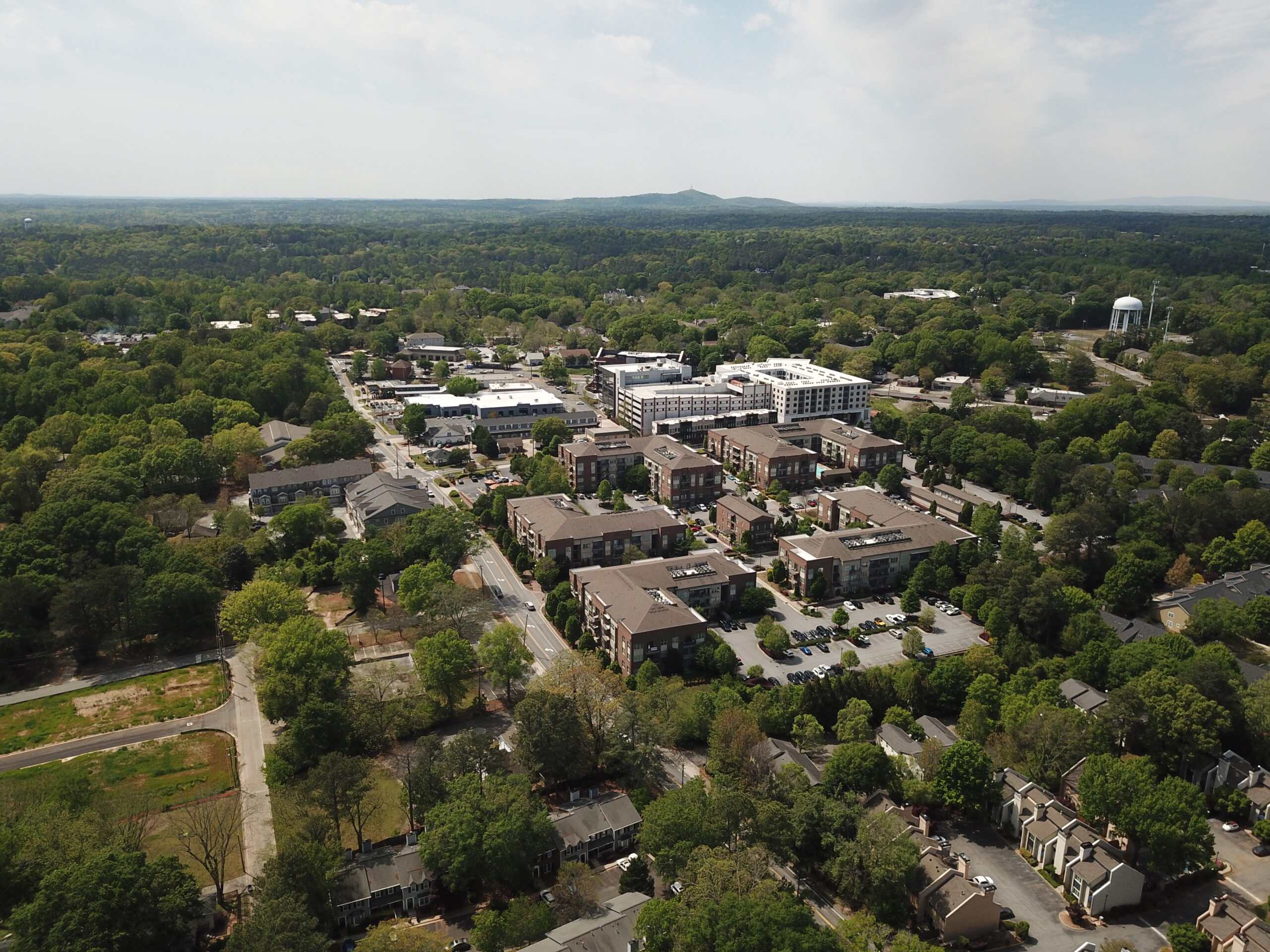


Metro Atlanta did not ease into the age of AI. It got drafted into the starting lineup. In under four years, the region went from a solid Southern tech market to one of the most important physical engines of artificial intelligence in North America, with server campuses rising along the interstates, billion dollar university investments in Midtown, and a quiet revolution happening inside thousands of Atlanta small businesses that now run on AI tools every single day. If you have been following our coverage of Roswell’s civic tech firsts and the Roswell Business Directory, you already know the local business landscape is changing fast. This article zooms out to the whole metro: what AI has actually done to Atlanta’s economy, what it means for small businesses in Metro Atlanta, and where the region goes next.
Understanding the AI Era in Metro Atlanta
When most people hear “AI,” they picture a chatbot. In Metro Atlanta, the AI story has three layers, and every local business owner sits somewhere on all three.
The infrastructure layer. This is the concrete, steel, and electricity. Data centers, power plants, transmission lines, and fiber networks that train and run AI models. Atlanta has become a national leader here.
The innovation layer. Universities, startups, venture capital, and research labs building the next generation of AI products. Georgia Tech, Emory, and a growing roster of funded Atlanta AI startups anchor this layer.
The adoption layer. This is where small businesses live. Generative AI for content, AI-powered customer service, automated scheduling, AI search visibility, and agentic workflows that handle routine tasks without a human pushing every button. This is the layer that decides which local businesses win customers over the next five years.
The infrastructure and innovation layers make headlines. The adoption layer makes payroll. Understanding how all three connect is the first step toward a smart AI strategy for any Atlanta small business.
Metro Atlanta’s AI Economy at a Glance
| Metric | Figure | Source (date) |
|---|---|---|
| Data center capacity under construction, Atlanta market | ~2,882 MW, most of any U.S. primary market | CBRE via WSB-TV (H1 2026) |
| Existing Atlanta data center inventory | ~1,803 MW | CBRE via WSB-TV (H1 2026) |
| Atlanta data center vacancy | 2% | CBRE (March 2026) |
| Georgia Tech and Emory AI infrastructure commitment | More than $1.1 billion | Atlanta News First (Oct. 2026) |
| Funded AI startups tracked in Atlanta | 40, with ~$3.5B raised combined | Seedtable (2026) |
| Small businesses using 6+ tech platforms | 41%, up from 14% in 2022 | U.S. Chamber of Commerce (2026) |
| Small businesses fully integrating AI into core operations | 14% | Goldman Sachs 10,000 Small Businesses (Feb. 2026) |
| Local service searches showing a Google AI Overview | 88% in a 400-search sample | Lilach Bullock study (2026) |
Figures current as of November 2026. Refresh before reshare.
The Data Center Boom: Atlanta Becomes the AI Engine Room
The single biggest physical impact of AI on Metro Atlanta is the data center build-out. AI models need enormous computing power, and computing power needs land, electricity, water, and fiber. Atlanta has all four.
Atlanta now leads North America in construction. According to CBRE’s North America Data Center Trends report for the first half of 2026, the Atlanta market had roughly 2,882 megawatts of data center capacity under construction, the highest of any U.S. primary market, on top of about 1,803 MW already in operation. Earlier in the year, CBRE reported that hyperscale and AI-driven demand had pushed Atlanta’s vacancy rate down to 2%.
The “AI superfactory” lives here. Microsoft brought its second Fairwater AI datacenter online in the Atlanta area, linking it to a sister site in Wisconsin through a dedicated fiber network. The company describes the connected system as its first AI superfactory, built to train frontier AI models in weeks instead of months.
Georgia’s footprint keeps expanding. The AI rush has now reached the coast. OpenAI’s “Project Camellia” is a $20 billion, 3.2 gigawatt data center campus planned for Effingham County near Savannah, with power delivered in phases from 2028 to 2032. It sits outside the metro, but it signals how central Georgia has become to the national AI buildout.
The ripple effect hits construction and industrial real estate. Regional construction employment in the Atlanta-Sandy Springs-Roswell metro reached 106,300 workers in January 2026, according to AGC tracking of BLS data. Data center-related firms are also leasing record amounts of Atlanta warehouse space, helping fill buildings during a broader warehousing slowdown.
For local contractors, electricians, HVAC companies, equipment suppliers, and the restaurants and service businesses that feed crews, the data center boom has been real money flowing through the regional economy.
The Local Response: Roswell, North Fulton and the Moratorium Wave
Growth this fast brings questions, and Metro Atlanta communities are asking them out loud.
Roswell hit pause early. On January 12, 2026, the same night new city leaders were sworn in, the Roswell City Council unanimously approved a temporary emergency moratorium on new data centers. The 90-day pause, set to run through April 12, gave staff time to review zoning, utility use, power grid concerns, and environmental issues, including potential effects on the Chattahoochee River. Mayor Mary Robichaux framed it as a data-gathering step, noting the city was “not saying we won’t ultimately maybe allow one.”
North Fulton and beyond followed. Roswell joined a long list of metro jurisdictions taking a closer look. DeKalb County has extended its moratorium into 2027, Chamblee paused new data center applications in July, and Cherokee County passed a 30-day moratorium of its own. In the city of Atlanta, council members have weighed a 23-member data center task force to study electricity, water, noise, land use, and tax base impacts.
What it means for local business owners. The moratorium wave is about land use, not about whether businesses should use AI. A Roswell boutique, dental office, or home services company can absolutely adopt AI tools whether or not a server campus is ever built inside city limits. The infrastructure debate and the adoption opportunity are two separate conversations.
Power, Price and the Grid
Every AI query runs on electricity, and in Georgia that conversation runs through Georgia Power and the Public Service Commission.
Massive capacity approvals. In late 2025, the PSC approved roughly ten gigawatts of new generating capacity, much of it to serve projected data center demand. Georgia Power has said around 80% of its projected demand growth comes from data centers.
A rate freeze, with a watchful eye. Base rates are frozen through 2028, and PSC leadership has argued that large-load customer revenue helps stabilize bills for everyday customers. In July 2026, the commission also approved an investigation into whether heavy industrial users like data centers are shifting costs onto residential customers.
The utility side of the ledger. Southern Company, Georgia Power’s Atlanta-based parent, reported that data center electricity sales jumped 42% in the first quarter of 2026 compared with a year earlier.
For small business owners, utility costs are a line item worth watching through 2028 and beyond, especially for energy-heavy operations like restaurants, salons, auto shops, and light manufacturing.
Universities, Startups and Capital: Atlanta’s AI Innovation Engine
The innovation layer is where Atlanta is building long-term AI talent and intellectual property.
A billion dollar bet on AI infrastructure. In October 2026, Georgia Tech and Emory University announced a combined investment of more than $1.1 billion in Georgia’s AI infrastructure, with a stated goal of making Atlanta a top five U.S. technology hub and keeping Georgia-trained talent in the state.
Supercomputing in Tech Square. Days later, Georgia Tech unveiled Nexus, a $20 million AI-focused supercomputer funded by the National Science Foundation and housed at the Coda Data Center. It blends AI and traditional supercomputing on one platform and is open to researchers nationwide.
A growing AI startup ecosystem. Seedtable tracks 40 funded AI startups in Atlanta that have raised roughly $3.5 billion combined, led by names like Flock Safety, Pindrop, and Sema4 AI. New capital keeps arriving too, including an Atlanta-based investor that unveiled nearly $500 million deployed into AI and deep tech startups this summer.
Hands-on training pipelines. In May 2026, Atlanta Technical College opened a Microsoft Datacenter Academy to train students to maintain the server infrastructure behind AI.
The Workforce Shift: Jobs, Skills and the Human Side of AI
AI’s impact on Atlanta jobs is real, uneven, and still unfolding.
Some sectors are feeling pressure. The AJC reported that Georgia’s information and professional and business services industries lost more than 5,000 jobs over a recent 12-month period, with AI cited as one factor among several, alongside prices and tariffs.
Employers are still hiring, and hunting for skills. Robert Half research found that nearly two-thirds of metro Atlanta employers planned to increase permanent hiring in the second half of 2026, even as many reported talent shortages delaying projects.
Soft skills are the new hard skills. The Metro Atlanta Chamber’s 2026 Talent Supply Report found employers doubling down on communication, problem-solving, and adaptability alongside technical expertise.
For small business owners, the takeaway is practical: AI rewards teams that know how to direct it. Upskilling your existing staff on AI tools is often a faster win than hiring.
What the Age of AI Means for Small Businesses in Metro Atlanta
Here is where the AI economy gets personal. National data paints a clear picture of how small businesses, including those across Roswell, Alpharetta, Marietta, Sandy Springs, Johns Creek, and the rest of the metro, are adopting AI.
Tech adoption has gone mainstream. The U.S. Chamber of Commerce’s 2026 small business technology report found that businesses using six or more technology platforms jumped from 14% in 2022 to 41% in 2026, and that 95% of small businesses using AI are working to upskill employees.
Usage is high, integration is shallow. A Goldman Sachs 10,000 Small Businesses survey found 76% of participants using AI, but only 14% fully integrating it into core operations. That gap between “trying AI” and “running on AI” is the single biggest opportunity for Atlanta small businesses right now.
The smallest shops face the biggest gap. A U.S. Chamber of Commerce Foundation report found that businesses with two to nine workers were significantly less likely to use AI than larger small businesses, even though they may have the most to gain.
Marketing is the front door. Marketing has become the fastest entry point for AI in small firms, with a majority of small businesses already using AI marketing tools for content, customer engagement, and analysis.
The most common AI use cases for local businesses right now include:
- AI content generation for social posts, blog articles, email campaigns, and ad copy
- AI customer service through chat, text, and automated call handling
- Workflow automation for scheduling, invoicing, quoting, and follow-ups
- AI-powered analytics that turn sales and marketing data into decisions
- Agentic AI that runs multi-step routine tasks on a schedule with minimal human input
The Search Shift: AI Overviews, AI Mode and Local Discovery
For any business that depends on being found online, AI has already rewritten the rules of local search.
AI answers sit above the blue links. A 2026 study of live local service searches found Google showing an AI Overview on 88% of local service queries in its sample. Separate industry reporting estimates that around 48% of U.S. consumers already use conversational AI to find local businesses.
Search is growing, clicks are harder to earn. Alphabet reported Google Search advertising revenue up 19% year over year in Q1 2026, tied in part to AI Overviews and AI Mode driving more queries. More searches, fewer organic clicks.
Local still has a moat. Whitespark’s 2026 Local Search Ranking Factors report describes local search as relatively insulated from AI disruption, because AI systems still need real-world signals: who you are, what you do, and where you do it.
That is why buzzwords like AEO (Answer Engine Optimization), GEO (Generative Engine Optimization), entity authority, and AI visibility have moved from conference slides into small business marketing plans. Consistent business listings, fresh reviews, structured data, and local mentions in community hubs like the Roswell Business Directory all feed the signals AI tools use to recommend businesses.
The Local Agency Angle: Testing Every Tool So Businesses Don’t Have To
With new AI platforms launching every week, many small business owners are leaning on local partners to separate real value from hype.
One of those partners is Pulse Media Group (PMG), a Roswell-based web development and digital marketing agency serving businesses across North Atlanta and the greater metro. PMG has built its approach around a simple philosophy: adopt every new technology available, put it through its paces, and decide whether it earns a permanent place in the agency’s stacks. Tools that deliver stay. Tools that do not get cut.
That test-everything mindset reflects a broader trend among forward-leaning Atlanta agencies, where AI adoption is treated as an ongoing research and development process rather than a one-time software purchase. For local business owners who do not have the time to evaluate dozens of AI platforms themselves, that kind of hands-on vetting is becoming a valuable service in its own right.
Where Metro Atlanta Goes From Here
The next chapter of AI in Metro Atlanta will be shaped by a handful of forces already in motion.
Infrastructure policy gets settled. As moratoriums expire and permanent ordinances replace them, cities like Roswell will decide where data centers fit, and where they do not. Expect clearer zoning rules across North Fulton and the wider metro through 2027.
The power conversation continues. The 2028 Georgia Power rate case and the PSC’s cost-shifting investigation will shape what businesses and residents pay for electricity in the AI era.
Talent pipelines mature. Georgia Tech, Emory, Atlanta Technical College, and the region’s HBCUs are building the workforce that will both build AI and put it to work inside local companies.
Small business AI moves from experiment to operations. The gap between “using AI” and “fully integrating AI” will close. Businesses that build AI into their marketing, customer experience, and back office will compete differently than those still testing chatbots.
Search keeps evolving. AI Overviews, AI Mode, and conversational assistants will continue reshaping how Metro Atlanta residents find restaurants, contractors, doctors, and shops. Local visibility will depend on digital presence that both people and AI systems can trust.
How to Choose Your Next AI Move: Final Thoughts for Atlanta Small Business Owners
You do not need a data center or a supercomputer to benefit from the age of AI. You need a plan. Here is a simple way to choose where to start:
- Start with your bottleneck. If leads are slow, start with AI-powered marketing and local search visibility. If your phone rings off the hook, start with AI customer service and scheduling automation. If admin eats your evenings, start with workflow automation.
- Audit your digital footprint. Make sure your website, Google Business Profile, and directory listings are accurate and consistent. AI tools pull from all of them.
- Pilot, measure, then scale. Test one AI tool for 30 to 60 days, track the results, and only expand what clearly works.
- Invest in your people. Train your team to use AI well. The businesses winning with AI are the ones whose people know how to direct it.
- Get local help when you need it. A local web development and digital marketing partner who already tests these tools can save months of trial and error.
Metro Atlanta is building the AI economy in real time. The servers are humming, the research dollars are flowing, and the customers are already searching differently. The opportunity now belongs to the local businesses that move from watching AI to working with it.
Ready to Put AI to Work for Your Metro Atlanta Business?
Pulse Media Group helps small businesses across Roswell, North Fulton, and Metro Atlanta with web development, digital marketing, local SEO, and AI-ready digital strategy. If you want a modern website, stronger local search visibility, and a team that tests new technology before recommending it, start the conversation today.
Visit pmgatlanta.com or call (404) 550-0038 to schedule a consultation.
Roswell Pulse: local news, local business, and the tech shaping where we live.