
The Real History of the Roswell Mill: Cotton, Courage, and the Ghost Stories That Remain
The mist rises early over Vickery Creek in Roswell, Georgia, curling through the skeletal remains of brick walls that once echoed with the thunder of looms and the voices of hundreds of workers. Stand among these ruins at dusk, and you might hear something carried on the wind—a sound like distant sobbing, or perhaps the rhythmic clatter of machinery long since silenced. The locals will tell you these are the ghosts of the mill workers, and after learning the true story of what happened here, you might believe them.
A Connecticut Yankee’s Southern Dream
The story begins not with ghosts, but with ambition. In the 1830s, a wealthy Connecticut businessman named Roswell King was looking for his next venture. King was no stranger to Georgia—he’d spent years in Darien on the coast, serving as an overseer for Major Pierce Butler’s rice plantations. But the brutal coastal summers and the lure of untapped water power drew his attention northward, to a place where the Chattahoochee River carved deep gorges through the Georgia piedmont.
What King discovered at Vickery Creek was nothing short of perfect: a three-hundred-foot gorge with powerful rapids that could drive the machinery of industry. Here was the power source that could fuel his vision of creating the largest cotton mill in North Georgia. But King dreamed bigger than just a factory. He envisioned an entire town—a planned community built on New England principles, with a central square, churches, stores, and housing for workers. It would be a Southern mill town with Yankee sensibilities.
Construction began in 1836. The first mill building rose four stories high, measuring eighty-eight feet long and forty-eight feet wide, though it would later expand to 140 by fifty-three feet. By 1839, the Roswell Manufacturing Company was officially incorporated by the Georgia General Assembly, and the looms were already turning raw cotton into finished textiles. That same year, King’s wife died, never having lived in the town that bore her husband’s name.
King brought five families from Darien to help establish the community, including his sons Barrington and Ralph, who would manage the mill’s day-to-day operations. Together, they built what would become one of the most successful textile operations in the antebellum South. The King family even constructed “The Bricks”—two residential buildings where mill employees lived in some of the first apartment-style housing in the United States.
The town grew steadily around the mill. By 1853, a second cotton mill had been added to the complex. Workers’ cottages dotted the hillsides. A flour mill, woolen mill, and tannery expanded the industrial base. By 1860, the Roswell Manufacturing Company had tripled its capital and doubled its workforce. Georgia ranked third in the nation in cotton cloth production, and the Roswell Mills stood at the forefront of that success.
But success came at a cost. In 1847-48, an outbreak of mumps and measles swept through the cramped, dark workers’ quarters, leaving over half the workforce stricken and three enslaved workers dead. The mills ran on water power from Vickery Creek, but they also ran on human labor—including enslaved people who built King’s mansion and the original mill structures, though the family’s reliance on slavery decreased as wage labor became the norm.
Roswell King never saw the town reach its full potential. He died in 1844 at age seventy-eight, a decade before Roswell was officially incorporated as a city in 1854. But his vision had taken root, and by the time storm clouds of war gathered over the South, Roswell was thriving.
The Gray Fabric of War
When the first shots of the Civil War rang out in 1861, the Roswell Mills quickly became a crucial cog in the Confederate war machine. The two cotton mills and the Ivy Woolen Mill produced “Roswell Gray”—a distinctive gray fabric that was sewn into Confederate uniforms. If you’ve ever wondered why Confederate soldiers wore gray instead of blue, the answer lies partly in factories like Roswell’s, churning out thousands of yards of practical, durable cloth.
The mills also produced tent canvas, rope, sheeting, and other essential military supplies. As men marched off to war, many wearing Roswell Gray on their backs, the workforce that remained behind consisted primarily of women and children. These mill workers—some as young as ten or twelve—worked twelve-hour shifts six days a week, their nimble fingers operating the looms and spindles that kept the Confederacy clothed and equipped.
The mill’s French superintendent, Theophile Roche, knew the operation was too valuable to lose. As Union forces under General William Tecumseh Sherman advanced toward Atlanta in the summer of 1864, Roche hatched a desperate plan. He flew a French flag over the woolen mill and claimed neutrality, hoping to save the factory from destruction.
For two days, it worked.
July 5, 1864: When Hell Came to Roswell
On July 5, 1864, Brigadier General Kenner Garrard’s cavalry rode into Roswell. Sherman needed to cross the Chattahoochee River, and Roswell represented a strategic crossing point just twenty miles north of Atlanta. Confederate General Joseph E. Johnston had already withdrawn his forces across the river, and they’d burned the bridge over Vickery Creek to slow the Union advance.
Garrard’s men soon discovered that Roche’s claim of neutrality was a lie. Inside the mill, they found cloth stamped with the letters “CSA”—Confederate States of America. The mills were actively producing materials for the enemy, and Sherman’s response was swift and merciless.
On July 7, 1864, Sherman issued an order that would become one of the most controversial acts of the Atlanta Campaign: “Destroy all the mills and factories thereabout, and arrest all people, male and female, connected with the factories, and send them under guard to Marietta.”
What happened next would haunt Roswell for generations.
The Deportation: 400 Souls Sent North
Imagine being a young woman, perhaps twenty years old, working at your loom when Union soldiers storm through the doors. Your husband is somewhere with the Confederate army—you haven’t heard from him in months. Your children are playing in the mill yard because you have no one to watch them while you work. And now these blue-coated men are telling you that you’re under arrest for treason.
This was the reality for approximately 400 mill workers on that July day. The vast majority were women and children, along with a few men too old or too young to fight. They were marched at gunpoint to Roswell’s town square, where they waited under guard in the summer heat. Some had only minutes to gather their belongings. Many couldn’t read or write, couldn’t leave messages for loved ones who were away.
After a day in the square, the workers were loaded into wagons and transported to Marietta, where they were imprisoned in the abandoned Georgia Military Institute. They remained there for a week, surrounded by the detritus of war, not knowing their fate.
Then came the trains.
The mill workers and their children were packed into boxcars with several days’ rations and sent north. The journey took them through Chattanooga and Nashville, eventually reaching Louisville, Kentucky—the final destination for many. Others were transported across the Ohio River into Indiana.
In Louisville, the refugees were temporarily housed and fed in a hospital, but they were soon left to fend for themselves in a strange city, far from home, in the midst of a war. Most of the women were illiterate and knew only mill work. They took whatever menial jobs they could find—washing clothes, cleaning houses, working in Northern factories. Some Indiana workers settled near riverfront mills, struggling to survive. Tragically, some turned to prostitution simply to stay alive.
Unable to send word home, not knowing if their husbands were alive or dead, many of the women eventually remarried in the North. Their children grew up as Yankees, forgetting the Georgia accents of their mothers.
Historical records suggest that only a handful ever returned to Roswell.
One woman, Adeline Bagley Buice, was heavily pregnant when Union forces arrested her while her husband Joshua served in the Confederate Army. Her story, like so many others, disappeared into the chaos of war. Some descended directly from these displaced workers have spent generations trying to trace what happened to their ancestors, piecing together fragments from city directories, marriage records, and cemetery records scattered across the Midwest.
Sherman’s order to deport the mill workers remains controversial to this day. While some historians argue it was a legitimate military action against Confederate suppliers, others see it as a war crime—the forced deportation of civilians, many of them women and children. A monument on Sloan Street in Roswell now honors these 400 souls, ensuring their story isn’t forgotten.
Ashes and Resurrection
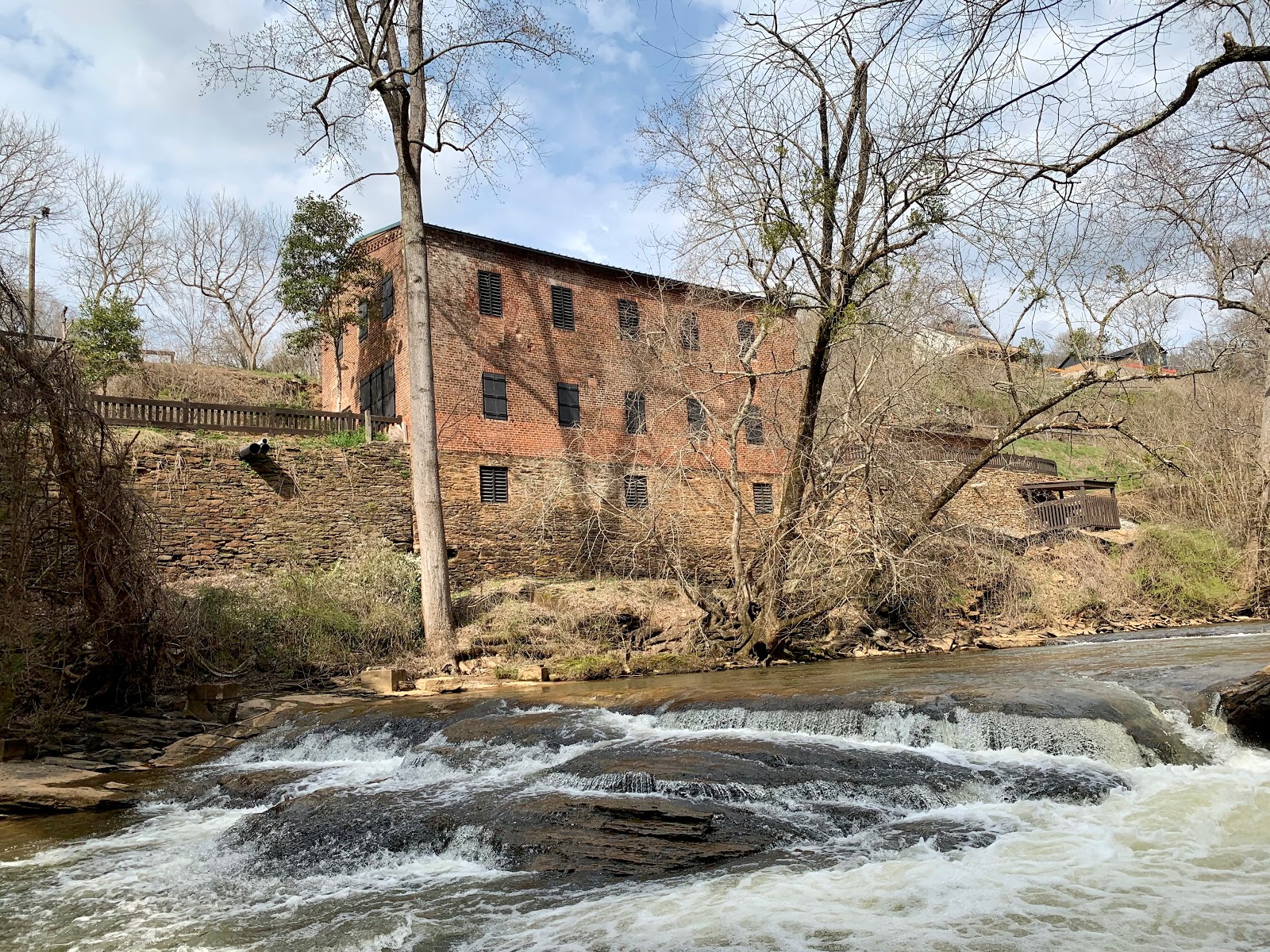
After arresting the workers, Union forces set fire to the mills. Flames consumed the buildings that had defined Roswell’s economy and identity. Only the 1839 machine shop—a two-story brick structure in late Georgian style—survived the conflagration. You can still see it today, standing as a silent witness to the destruction that swept through the town.
The Confederate forces had already burned the bridge over Vickery Creek, and now the mills themselves were reduced to smoking ruins. For Roswell, it was a double devastation: the economic engine destroyed, and its workforce—the heart of the community—torn away and scattered across the North.
After the war, the slow work of rebuilding began. One of the cotton mills and the woolen factory were reconstructed. In 1882, a second cotton mill rose from the ashes. The mills adapted to survive, adding steam power in 1897 while still relying on Vickery Creek’s hydropower. In 1920, the Easley Cotton Mills of South Carolina purchased the complex for $800,000—a fortune that reflected the operation’s value, with 120 looms and 12,000 spindles humming away.
But the mills that rose from the ruins never quite recaptured the antebellum glory. Ownership changed hands frequently as the textile industry grew increasingly competitive. In 1926, lightning struck, causing a fire that resulted in $400,000 in damage—as if the land itself couldn’t forget the flames of 1864.
The mills continued operating, churning out textiles through two world wars and into the modern age. But by 1975, the era of King Cotton had definitively passed. Competition from overseas manufacturers made the operation unsustainable, and the looms finally fell silent after nearly 140 years.
The buildings were eventually converted into offices, but the original mill ruins were left to nature. In 1974, parts of the complex were added to the National Register of Historic Places as part of the Roswell Historic District. Today, the site falls under the jurisdiction of the National Park Service as part of the Chattahoochee River National Recreation Area.
The Mill That Built a City
It’s impossible to overstate how completely the mill shaped Roswell’s identity. Before the mill, this was Cherokee land, a bend in the Chattahoochee River with no European settlement. The mill didn’t just provide jobs—it was the reason Roswell existed at all.
Roswell King’s vision of a planned community created a unique Southern town with distinctly Northern characteristics. The central square, the New England-influenced architecture, the emphasis on manufacturing rather than agriculture—all of these set Roswell apart from typical Georgia towns of the era.
The mill attracted workers and their families, who needed housing, stores, churches, and schools. Merchants opened shops to serve the mill workers. Professional men—doctors, lawyers, craftsmen—settled in town to serve the growing population. The wealthy mill owners built grand antebellum mansions that still stand today: Bulloch Hall, Barrington Hall, and others that now serve as museums and event venues.
When the mills burned in 1864, it could have been the end of Roswell. Many Southern mill towns never recovered from Sherman’s destruction. But Roswell’s location—close enough to Atlanta for commerce, situated on the Chattahoochee River for transportation and power—ensured its survival. The mills rebuilt, and with them, the town rebuilt.
Even after the mills finally closed in 1975, Roswell continued to thrive. The town had diversified beyond textiles, its historic character attracting residents who commuted to Atlanta while living in a community rich with history. Today, Roswell is one of Georgia’s ten largest cities, a thriving suburb with a fiercely protected historic district at its heart.
Walk through Old Mill Park today, and you’ll see hikers on the trails, photographers capturing the waterfall, families crossing the covered pedestrian bridge. The ruins themselves—brick walls, forgotten chimneys, massive steel gears half-buried in the earth—have become beloved landmarks. They’re picturesque now, softened by time and moss, their harsh industrial edges gentled into something almost romantic.
But stand there as the sun sets, as shadows lengthen through the ruins, and remember: this place was built on dreams and labor, destroyed by war and fire, haunted by injustice and loss.
The Ghosts of Vickery Creek
Which brings us to the ghosts.
Roswell locals will tell you that the mill ruins and the surrounding area are among the most haunted sites in Georgia. Paranormal investigators have documented decades of unexplained phenomena. The stories are remarkably consistent, passed down through generations and corroborated by visitors who knew nothing of the legends before their encounters.
The most famous spirit is the Weeping Woman of Vickery Creek. She’s described as wearing a flowing white dress, appearing near the covered bridge or along the creek itself. Witnesses report hearing soft sobbing—heart-wrenching cries that seem to come from nowhere and everywhere at once. When they investigate, they find no source, no mourning woman, nothing but the sound of water over rocks.
Local lore identifies her as one of the deportees, forever searching for the children torn from her arms on that terrible July day. Some say she’s searching for her husband, who returned from war to find his family vanished. Hikers have reported seeing her at dusk, standing at the water’s edge, before she fades like morning mist.
In the ruins themselves, visitors frequently report shadow figures darting between the old brick pillars. These dark shapes move with purpose, as if still working the looms that no longer exist, running errands that no longer matter. Ghost hunters with EMF detectors report spikes in electromagnetic activity in certain areas, particularly near the old foundations.
The sounds are perhaps the most unnerving. Multiple visitors—many who knew nothing of the mill’s history—have reported hearing mechanical sounds among the ruins: the rhythmic clatter of looms, the groan of water wheels, the clang of metal on metal. These sounds are most often reported after dusk, when the park is officially closed and no living soul should be present.
There are the voices, too. Fragments of conversation in accents both Southern and Northern. The laughter of children playing. The sharp command of a foreman calling out instructions. And underneath it all, some visitors swear they hear weeping—dozens of voices crying in unison, a chorus of grief that seems to rise from the very stones.
One old mill house in historic Roswell, purchased in the 1990s by a woman named Vicky, became the center of persistent paranormal activity. She attempted renovation multiple times, but each time she returned to find the building soaked with water, her improvements destroyed. A psychic medium investigated and claimed to sense five spirits—the wives of mill workers who left to fight in the Civil War and never returned. The women, the psychic said, were waiting for their husbands, maintaining the home for a reunion that would never come.
The Public House on the town square, which served as a commissary for the mill during the Civil War, has its own tragic ghost story. Local legend tells of Katherine, the daughter of the building’s owner, who fell in love with a young Union soldier named Michael. In that divided time, their romance was scandalous, even treasonous. Michael was caught and hanged from a tree across the street while Katherine watched in horror from an upstairs window. Employees and visitors report seeing two figures dancing in the loft, hearing piano music when no one is playing, finding glasses that move across the bar by themselves. Katherine, they say, is still waiting for her Michael, still dancing to music only she can hear.
Another building, known locally as “Catherine’s Cottage,” was once home to mill workers. A law firm now occupies the structure, but when electricity was first installed, workers would arrive to find the building flooded. A psychic claimed that the resident ghost, Catherine, thought the wiring was “fire in the walls” and was trying to extinguish it. Today, the law firm reports a peaceful coexistence with Catherine, though papers are sometimes found scattered inexplicably.
Founders Cemetery, where Roswell King himself is buried, is a hotspot for paranormal activity. Visitors have reported camera malfunctions, sudden battery drainage in electronic devices, unexplained cold spots on warm days, and the sensation of being watched. Some have captured strange orbs and mists in photographs—artifacts that could be dismissed as dust or moisture, or could be something more.
Why So Haunted?
Paranormal researchers offer several theories about why Roswell seems to be particularly active with spiritual energy. The gorge along Vickery Creek is up to three hundred feet deep in some places, and archaeological evidence suggests humans have inhabited this area for at least six thousand years. That’s six millennia of people living, loving, working, and dying—layers upon layers of human emotion soaked into the land.
There’s also the geological factor. A large fault line reportedly runs beneath Roswell, and paranormal investigators note that such geological features often correlate with increased supernatural activity. The theory is that when fault lines shift, they emit strong electromagnetic frequencies that spirits can use as energy to manifest.
The violent and emotionally charged events of July 1864 may have left what researchers call a “residual haunting”—a psychic imprint of trauma so powerful that it plays back like a recording. The fear, grief, and betrayal experienced by the mill workers as they were torn from their homes and sent into exile, the desperation of the soldiers burning the town’s livelihood, the anguish of families separated—these intense emotions might have literally soaked into the stones and earth.
Some believe the spirits are still searching—for loved ones, for home, for justice. The mill workers who never returned from the North, who died far from Georgia among strangers, might not rest easy. The soldiers who died in battles fought across Georgia might have returned to the place they knew as home. The children who grew up in the mill village, who played among the buildings now reduced to ruins, might still be playing there in some dimension we don’t fully understand.
Walking Among Whispers
Today, the Roswell Mill ruins and Old Mill Park attract thousands of visitors each year. Most come for the natural beauty—the waterfall created by the dam, the hiking trails along Vickery Creek, the picturesque covered bridge built in 2005 from Douglas Fir. The ruins themselves are hauntingly beautiful, especially when softened by morning mist or touched by the golden light of late afternoon.
But if you visit at dusk, as the park officially closes and the last hikers make their way back to the parking lot, the place takes on a different character. The shadows grow longer. The sound of the water over the falls seems louder, more insistent. And if you stand very still among the old brick walls, you might feel it—a presence, a weight in the air, the sense that you’re not quite alone.
The Roswell Ghost Tour has been operating for over twenty-five years, led by experienced paranormal investigators who have appeared on shows like SyFy’s “Ghost Hunters.” They take groups through the historic district, sharing documented encounters and encouraging visitors to experience the haunted sites for themselves. The tour stops at antebellum mansions, old mill workers’ apartments, and yes, the ruins themselves—places where the boundaries between past and present seem thinner than usual.
Whether you believe in ghosts or not, there’s no denying the emotional weight of this place. The ruins are beautiful, but they’re also testament to dreams and destruction, to the people who built their lives here and the forces that tore those lives apart.
Echoes in Stone
The real history of the Roswell Mill is a story of ambition and industry, of King Cotton’s rise and fall, of a community built from nothing into one of Georgia’s great cities. It’s a story of the Civil War’s brutality, of a military action that still divides historians and haunts descendants. It’s a story of resilience, of a town that rebuilt from ashes and redefined itself again and again.
But it’s also a story written in absence—in the workers who never came home, in the families torn apart, in the lives interrupted and rerouted by violence. Every brick in those ruins represents someone’s labor. Every spindle that once turned carried thread spun by human hands. Every yard of Roswell Gray that clothed a soldier was woven by women and children whose names we’ll never know.
The mills are silent now. The looms are gone. The workers’ voices have faded into history. But on certain evenings, when the light is just right and the wind carries whispers through the gorge, you might hear something—an echo of all that was built here, all that was lost, all that remains.
The Roswell Mill ruins stand as a monument to a complex history that can’t be simplified or sanitized. They remind us that progress often comes at a cost, that industry is built on human toil, that war’s consequences ripple forward through generations. They challenge us to remember not just the grand mansions and successful businessmen, but also the forgotten workers—especially the 400 women and children whose lives were forever altered by a single military order on a July day in 1864.
Whether the ghosts are real or simply the weight of history pressing on our consciousness, the stories demand to be told. The mill workers deserve to be remembered. Their labor built Roswell. Their sacrifice—willing or not—became part of the town’s foundation.
So visit the ruins. Walk the trails. Stand on the covered bridge and listen to the water below. Read the plaques and imagine the mill in its heyday—six buildings humming with activity, hundreds of workers moving between tasks, raw cotton arriving and finished cloth departing.
Then close your eyes and remember what happened here. Remember the fires. Remember the deportation. Remember the women crying in boxcars, heading north to uncertain fates. Remember the children who never saw Georgia again. Remember that history isn’t just about the winners and the wealthy—it’s about everyone who lived through it, especially those whose names were never written down.
The Roswell Mill ruins are haunted, yes. But not just by ghosts. They’re haunted by memory, by injustice, by loss, by resilience. They’re haunted by all the lives that intersected here—the enslaved people who built the first buildings, the workers who ran the looms, the soldiers who burned it all down, the builders who raised it again, and the descendants who refuse to let the story die.
Stand in those ruins at dusk, and you’re standing in all of that history at once. The past isn’t past here—it’s present, pressing close, whispering its truths to anyone willing to listen.
And in the gathering darkness, when you hear something—a sound like sobbing carried on the wind, like the ghost of machinery, like voices calling across the years—maybe that’s exactly what it is. Maybe the mill workers are still trying to tell their story. Maybe the only way they can rest is if we finally, truly hear them.
The ruins remain. The creek still flows. And the ghosts, whether supernatural or simply the weight of collective memory, continue to haunt this beautiful, terrible, unforgettable place.
If you visit the Roswell Mill ruins at Old Mill Park, please respect the site and its history. The park officially closes at dusk. Many ghost tours operate in the area year-round, offering guided experiences led by knowledgeable historians and paranormal investigators. The mill ruins are part of the Chattahoochee River National Recreation Area, maintained by the National Park Service. Trail maps and historical information are available at the visitor center at 617 Atlanta Street in Roswell’s historic square.