
How the Chattahoochee
Shapes Life, Recreation, and Real Estate
in Roswell, Georgia
A comprehensive guide to the river that defines a community
There are cities built near water, and then there are cities built by water — communities where a river doesn’t just happen to be nearby but actively shapes the culture, the identity, the daily rhythms, and even the real estate values of everyone who lives there. Roswell, Georgia is the latter. The Chattahoochee River is not incidental to Roswell’s story. It is the story.
The river has been here longer than the city, longer than European settlement of the region, longer than the Cherokee towns that preceded it. It carved the forested bluffs that make western Roswell so dramatically beautiful. It powered the textile mills that gave Roswell its economic reason for being in the 19th century. It absorbed the chaos and tragedy of the Civil War era. And today, it draws kayakers, anglers, trail runners, wildlife watchers, and homebuyers who are willing to pay a significant premium for the privilege of waking up near its banks.
This guide is about all of that — the history, the recreation, the ecology, the neighborhoods, and the real estate market that has grown up around one of Georgia’s most beloved waterways. Whether you’re considering a move to Roswell, a longtime resident curious about your own backyard, or simply someone who wants to understand what makes the Chattahoochee so special, this is the story of a river and the city it shaped.
| 430 Total River Miles from Appalachia to Florida | 48 CRNRA Acres (000s) federally protected corridor | 5M+ Annual Visitors Chattahoochee Nat’l Rec. Area |
PART ONE: THE RIVER THAT BUILT ROSWELL
Understanding Roswell means understanding the Chattahoochee — not just as a geographic feature, but as the force that put this city on the map in the first place.
Ancient Waters, Ancient Peoples
The Chattahoochee River has been a gathering place for human civilization for thousands of years. Long before Roswell existed as a municipality, the river corridor was home to successive waves of Native American cultures, most recently the Cherokee Nation, who called this stretch of the Chattahoochee home until their forced removal during the Trail of Tears in the late 1830s. Cherokee place names and cultural imprints remain embedded in the regional landscape — a reminder that the history of this river is far older and richer than the two centuries of American settlement that followed.
The river’s character in the Roswell stretch is defined by the Piedmont geology that the water has spent millennia cutting through. This isn’t a lazy lowland river; it moves with purpose, dropping over shoals and boulders, cutting through forested ravines, and creating the kind of dynamic, oxygen-rich water that supports diverse aquatic life and makes for excellent recreational use. The topography it created — the steep bluffs, the hidden creek valleys, the forested floodplains — is the same topography that makes western Roswell among the most beautiful residential environments in suburban Atlanta.
The Mill Era: When the River Powered Industry
Roswell’s founding as a modern city is directly tied to the Chattahoochee’s industrial potential. In 1839, Roswell King, a Connecticut-born plantation manager and entrepreneur, recognized the waterpower potential of Vickery Creek — a tributary of the Chattahoochee — and established the Roswell Manufacturing Company. The mill complex he built became the economic engine of a planned community that King designed and populated with families he recruited from the Georgia coast and beyond.
The mills produced cotton and wool textiles that were distributed throughout the South. The town of Roswell grew up around the mills, with workers’ cottages, a company store, churches, and the grand plantation homes of the founding families clustering on the bluffs above the creek and river. For over two decades, the mill complex was one of the most successful industrial operations in Georgia.
Then came the Civil War. In July 1864, Union General William T. Sherman’s forces reached Roswell during the Atlanta Campaign. Upon discovering that the mills were producing cloth for Confederate uniforms, Sherman ordered them burned and, controversially, ordered the arrest and deportation of the approximately 400 mill workers — mostly women and children — on charges of treason. The Roswell Mill Workers became one of the Civil War’s most poignant stories of civilian displacement, and their fate remains a subject of historical research and memorialization to this day.
The ruins of the Roswell Mill complex still stand today, preserved as a historic site along Vickery Creek. They are among the most evocative Civil War-era ruins in the entire state of Georgia — stone walls rising from the creek bank, silent testimony to industry, war, and the resilience of a community. Walking the trail past those ruins connects you to 180 years of Roswell history in a way that no museum exhibit can quite replicate.
🏛️ Historic Site: The Roswell Mill ruins along Vickery Creek are a Roswell Historic Preservation Commission landmark and a key stop on the Vickery Creek Trail. Free and open year-round.
The Chattahoochee After Industry
Through the late 19th and early 20th centuries, the Chattahoochee in the Roswell area transitioned from industrial workhorse to recreational asset. As Atlanta grew northward, the river corridor became increasingly valued for its natural beauty and outdoor recreation potential. Decades of advocacy by conservation organizations and local citizens culminated in a landmark achievement: the establishment of the Chattahoochee River National Recreation Area (CRNRA) in 1978.
The CRNRA designation was transformative. By bringing roughly 48,000 acres of the river corridor under federal protection across 16 units spanning 48 miles from Buford Dam to Peachtree Creek, it permanently protected the natural character of the river from the development pressures that had consumed so much of suburban Atlanta’s natural landscape. Roswell sits within one of the most significant sections of the CRNRA, with multiple access units within or adjacent to city limits.
PART TWO: THE LIVING RIVER — ECOLOGY & WILDLIFE
The Chattahoochee is more than scenery. It’s a functioning ecosystem that supports an extraordinary range of wildlife and plant life — much of it visible to anyone willing to spend time on its banks.
The Water Itself
The Chattahoochee River in the Roswell stretch is classified as a coldwater fishery — an unusual designation for a river in the Deep South. Cold, clear water releases from Buford Dam (about 30 miles upstream) maintain water temperatures significantly lower than the surrounding air, creating conditions that support cold-water species, most notably trout, that would otherwise be impossible to sustain at this latitude.
This thermal characteristic makes the Chattahoochee through Roswell a genuinely unusual fishery — one of only a handful of urban trout fisheries in the entire eastern United States. It also contributes to the river’s clarity and the quality of the aquatic environment, supporting a diverse invertebrate community that in turn supports fish, birds, and other wildlife.
Water quality in the Chattahoochee has improved significantly over the past few decades, driven by improved wastewater treatment, stormwater management, and reduced agricultural runoff in the watershed. Organizations like the Chattahoochee Riverkeeper have been instrumental advocates for the river’s health, monitoring water quality and holding polluters accountable. The result is a cleaner, healthier river than existed a generation ago — though ongoing vigilance remains essential as development pressures in the watershed continue.
🌊 Water Quality: The Chattahoochee Riverkeeper monitors water quality at multiple points along the river and publishes real-time data at chattahoochee.org. Check before swimming or prolonged water contact.
Fish: A World-Class Urban Fishery
For anglers, the Chattahoochee through Roswell represents something genuinely extraordinary: a world-class trout fishery located within 25 miles of downtown Atlanta. The river supports healthy populations of rainbow trout and brown trout stocked and managed through a combination of Georgia Wildlife Resources Division programs and the wild trout population that has established itself in particularly favorable stretches.
Beyond trout, the warm-water sections of the river support largemouth bass, smallmouth bass, spotted bass, striped bass (particularly in the shoal areas), catfish, and a variety of panfish. This incredible diversity makes the Chattahoochee a destination fishery that draws serious anglers from across the Southeast.
Kayak angling on the Chattahoochee has exploded in popularity over the past decade, and Roswell’s position along the river makes it a hub for this activity. The Georgia Kayak Fishing community — one of the most active kayak fishing organizations in the South — has organized numerous events and tournaments on this stretch of river, introducing hundreds of anglers to a fishery many of them didn’t realize existed in their own metropolitan area.
🎣 Fishing Licenses: Georgia fishing licenses are required and available online at georgiawildlife.com. A Georgia trout stamp is required for trout fishing. The Chattahoochee is catch-and-release only in certain sections — check current regulations before fishing.
Birds: A Birder’s Paradise
The forested river corridor in Roswell supports a remarkable diversity of bird life that surprises many residents who have never thought to look up while hiking the trails. The riparian habitat — the combination of water, forested slopes, and open river channel — creates conditions that attract both resident species and a remarkable variety of migratory birds during spring and fall.
Great blue herons are year-round residents, stalking the shallows with prehistoric patience. Belted kingfishers patrol the river with their characteristic rattling call, plunging for fish with impressive accuracy. Osprey fish the Chattahoochee from spring through fall, hovering and diving in dramatic fashion. In winter, bald eagles are regular visitors to productive fishing areas. Wood ducks nest in the forested riverside, and the dawn chorus of songbirds along the Vickery Creek Trail and Sope Creek trails in spring is genuinely spectacular.
For serious birders, the CRNRA units within Roswell are documented hotspots with substantial eBird checklists demonstrating the diversity of species present throughout the year. The combination of forested uplands, riparian woodland, and open water creates habitat complexity that supports everything from secretive woodland warblers to raptors to waterfowl.
Other Wildlife
The river corridor’s wildlife extends well beyond fish and birds. White-tailed deer are abundant throughout the forested sections and regularly visible to trail users, particularly in early morning and evening. River otters — once absent from much of the upper Chattahoochee due to water quality issues — have made a strong comeback and are regularly sighted by paddlers and trail users. Beaver activity is evident along many sections of the river and its tributaries, with dams and lodge structures visible from the trails.
Reptile diversity is high: box turtles are common on the trails, aquatic turtles bask on logs throughout the river, several species of non-venomous water snakes are abundant (and frequently mistaken for the far rarer copperhead), and the occasional alligator snapping turtle lurks in the deeper river pools. For families and school groups, the river corridor is essentially a living natural history classroom.
PART THREE: THE RECREATION RIVER
The Chattahoochee through Roswell supports one of the most diverse arrays of outdoor recreation available anywhere in the Atlanta metro area. From flatwater kayaking to technical trail running, the river corridor has something for everyone.
Paddling: Kayaks, Canoes & Tubes
🛶 Kayaking & Canoeing — The premier Chattahoochee experience
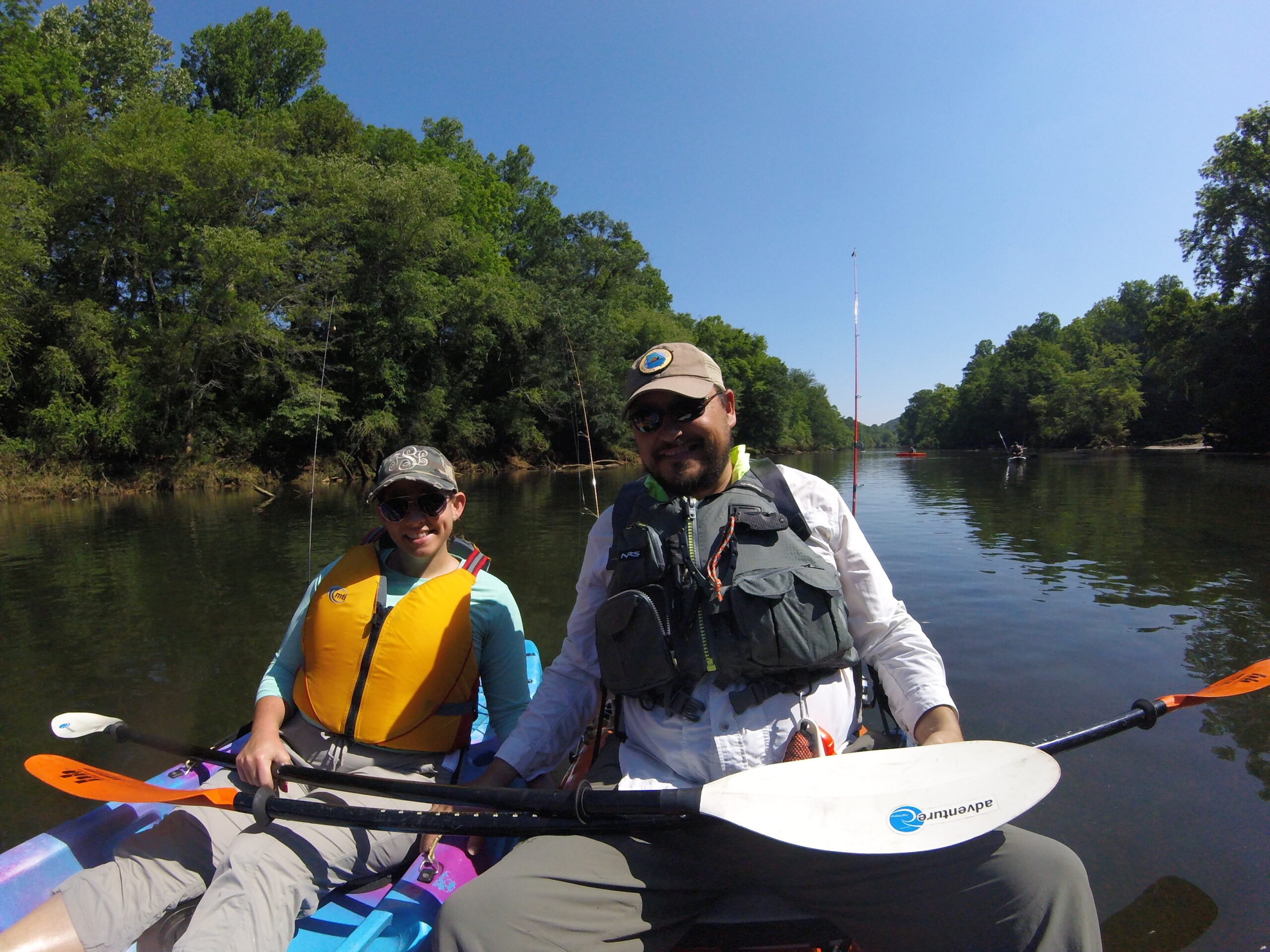
Paddling the Chattahoochee through the Roswell section is one of those experiences that fundamentally changes how you understand where you live. From the water, the city virtually disappears — replaced by forested bluffs, open sky, shoals that require genuine navigation, and wildlife that treats the river as if humans had never arrived. It’s a perspective on Roswell that most residents never experience, and those who do tend to become devoted regulars.
The stretch of river through the CRNRA units near Roswell varies from relatively gentle flatwater sections ideal for beginners to technical shoals that reward experienced paddlers. The Azalea Park and Island Ford units provide excellent put-in and take-out options for multi-hour float trips. Rental equipment is available from several outfitters near the river, and guided tours are an excellent option for first-time paddlers who want an orientation before venturing out independently.
Kayak anglers have found the Chattahoochee through Roswell to be particularly productive water. The combination of trout in the colder upper sections and bass throughout creates a remarkably diverse fishing float, and the river’s character — with alternating pools, shoals, and eddies — provides endless variety for anglers who know how to read moving water. It’s one of the main reasons Roswell has become something of a hub for the kayak fishing community in Georgia.
Best Access Points: Azalea Park, Island Ford Unit (CRNRA), Gold Branch Unit
Float Length: Typical Roswell float sections run 4–8 miles and take 2–5 hours
Skill Level: Beginner to intermediate depending on section; check current water levels
🚣 Tubing — The quintessential summer river tradition
Every summer, thousands of Atlantans make the pilgrimage to the Chattahoochee for tubing — a tradition as deeply embedded in Atlanta-area culture as Braves baseball and peach season. The upper sections of the river near Roswell and Helen have been popular tubing destinations for generations, and the activity’s combination of zero skill requirement, social nature, and genuine outdoor experience makes it a perennial summer favorite.
The Chattahoochee Outdoor Center operates a popular tubing concession near Roswell/Sandy Springs, providing tube rentals and shuttle service for the standard float. A weekday trip is significantly more relaxed than the weekend crowds, and early morning launches allow tubers to enjoy the river in relative solitude before the day heats up and the crowds arrive.
☀️ Summer Tip: Tubing crowds peak on summer weekends between Memorial Day and Labor Day. Weekday morning trips offer the same river experience with a fraction of the crowds. Sunscreen, water, and a dry bag for your phone are essential gear.
Hiking & Trail Running
🥾 Vickery Creek Trail — Roswell’s crown jewel hiking destination
If you’ve only done one hike in Roswell, it was almost certainly Vickery Creek. This remarkable trail winds through a forested ravine past the ruins of the historic Roswell Mill, descends to Vickery Creek, and follows the creek to its confluence with the Chattahoochee River. The combination of natural beauty, Civil War history, and dramatic topography makes it one of the finest urban-adjacent hiking experiences in the entire state of Georgia.
The trail system in the Vickery Creek unit of the CRNRA offers several miles of interconnected paths ranging from easy creek-side walking to more challenging ridge and ravine terrain. Trail runners have adopted Vickery Creek as a serious training ground, and the combination of technical terrain and manageable distances makes it an excellent option for fitness-focused trail enthusiasts who don’t want to drive to the mountains for a quality workout.
In spring, the wildflower display along Vickery Creek is outstanding — trillium, bloodroot, mayapple, and dozens of other species blanket the forest floor in a succession of blooms from late February through May. Fall color is equally spectacular, with the forest canopy turning brilliant shades of red, orange, and gold against the backdrop of the stone mill ruins.
Distance: 3–6+ miles depending on route combination
Difficulty: Moderate — some steep sections and creek crossings
Best Season: Spring for wildflowers; fall for color; manageable year-round
🌿 Sope Creek Trail (CRNRA) — History and wilderness in perfect balance
The Sope Creek unit of the Chattahoochee River National Recreation Area sits just south of Roswell proper and offers a hiking experience that rivals Vickery Creek in quality. Like Vickery Creek, Sope Creek features the ruins of a Civil War-era paper mill alongside beautiful creek-side forest, but the Sope Creek trail system is larger and offers more route options for those who want a longer or more varied outing.
The Sope Creek paper mill ruins are particularly atmospheric — stone walls rising from the forest floor, taken back by moss and vines over 160 years, with the creek rushing past below. The ruins and surrounding forest have appeared in numerous Atlanta-area publications and Instagram feeds as examples of the hidden natural treasures that exist within the metro area’s seemingly endless suburbs.
Access: Parking available at Columns Drive trailhead (technically Marietta/Cobb County, but the trail extends into the Roswell-area CRNRA corridor)
Distance: 4–7 miles of trail network
🏃 Gold Branch Unit (CRNRA) — The insider’s river access point
Less crowded than Island Ford but no less beautiful, the Gold Branch unit of the CRNRA provides direct Chattahoochee River access via a forested trail that descends from the trailhead to the river bank. The unit is a favorite among locals who want to escape the weekend crowds at more popular access points and simply sit by the river, fish, or enjoy a quiet stretch of natural beauty.
The trail to the river is relatively short but includes some elevation change, and the reward — a beautiful, secluded stretch of the Chattahoochee with shoals, exposed rock, and excellent fishing — is well worth the brief effort. Bird life along this trail is particularly rich in the early morning hours.
Other River Recreation
The Chattahoochee corridor near Roswell supports a full spectrum of outdoor activities beyond paddling and hiking:
- Cycling: The river road network and park access roads provide cycling opportunities, and several mountain biking trails exist within the broader CRNRA system.
- Swimming: Several shoal areas along the river are popular with waders and swimmers in summer, though swimming in moving water carries inherent risks that should be respected. Check water quality reports before extended contact.
- Photography: The combination of dramatic scenery, wildlife, wildflowers, fall color, and Civil War ruins makes the Chattahoochee corridor one of the finest photography destinations in the Atlanta region. Golden hour light on the river is simply extraordinary.
- Dog Walking: The CRNRA trails are dog-friendly (on leash) and are among the most popular dog exercise destinations in North Fulton County. The combination of interesting smells, water features, and forested terrain makes them genuinely enriching for dogs as well as their owners.
- Wildlife Observation: Patient visitors who sit quietly near the river in morning or evening hours are regularly rewarded with encounters with deer, otters, herons, kingfishers, and a remarkable variety of woodland birds.
PART FOUR: THE REAL ESTATE RIVER
Proximity to the Chattahoochee doesn’t just improve quality of life in Roswell — it demonstrably affects property values, neighborhood character, and the kind of buyer the market attracts.
The River Premium: What Proximity Is Worth
Real estate agents and appraisers in the North Atlanta market have long observed what buyers already know intuitively: properties with Chattahoochee River access, river views, or proximity to CRNRA trail systems command significant premiums over comparable properties without these features. In a market where the difference between two otherwise similar homes can be determined by which one has a view of trees versus a view of a neighbor’s garage, the Chattahoochee represents one of the most powerful value drivers in the entire Roswell market.
The river premium in Roswell operates at multiple levels. At the highest end, custom homes on private river-front lots along Azalea Drive and the western Roswell bluffs represent some of the most expensive residential real estate in the entire Atlanta metro — properties where the river view and direct water access are themselves the primary product. In the mid-market, communities like Martin’s Landing — built around private lakes connected to the river corridor — command prices above what their house-for-house characteristics would otherwise justify. And even the proximity premium — simply being within a 10-minute walk of a CRNRA trailhead — measurably affects values compared to otherwise equivalent neighborhoods farther from the water.
| 15-30% Typical River Premium vs. comparable inland homes | $600K+ River-View Median western Roswell bluff corridor | Top 5% Roswell Ranking Atlanta metro waterfront values |
River-Adjacent Neighborhoods: A Real Estate Profile
🏡 Azalea Drive / Willeo Road Corridor — The premier address
The stretch of homes along Azalea Drive and the connecting roads of the Willeo Road corridor represents the most exclusive residential real estate in Roswell’s river district. These properties sit on or near the bluffs above the Chattahoochee, offering dramatic views of the forested river corridor and, in many cases, direct access to the water via private paths or community easements.
Homes in this corridor tend toward the custom and semi-custom end of the market — architecturally distinctive properties on substantial lots with mature landscaping and the kind of privacy that’s increasingly hard to find in suburban Atlanta. The market here is driven by buyers who have deliberately chosen the river lifestyle: outdoor enthusiasts, people who value natural beauty over proximity to retail, and buyers willing to accept longer commutes in exchange for an extraordinary home environment.
Price points in this corridor are among the highest in Roswell, with median home values consistently well above the city average and the most desirable river-view properties regularly trading in the seven-figure range. New construction in this area is limited by lot availability and topographic constraints, which has historically supported strong appreciation in the existing housing stock.
Price Range: $500K – $2M+ depending on lot, view, and home characteristics
Best For: Luxury buyers, outdoor enthusiasts, buyers prioritizing privacy and natural beauty
Character: Custom homes, estate lots, significant privacy, forested environment
🏘️ Martin’s Landing — Community-centered river living
Martin’s Landing occupies a special place in Roswell’s real estate landscape as a community that has delivered on its ambitious original vision: a planned residential development built around natural assets, community infrastructure, and a genuine sense of neighborhood identity. Developed primarily in the 1970s and 1980s along the river corridor, Martin’s Landing was designed from the ground up to integrate its residents with the natural environment through community lakes, extensive trail systems, and direct Chattahoochee River access.
The community’s centerpiece is its two lakes — Lake Avondale and Lake Martin — which serve as the social hub of neighborhood life. The lakes support swimming, kayaking, fishing, and paddleboarding for community members, and the swimming beaches and lakeside common areas host community events throughout the warm-weather season. Miles of walking trails connect the lakes to the broader river corridor and create an internal greenway that makes getting around without a car practical for recreation purposes.
Real estate in Martin’s Landing offers something increasingly rare: a genuine community of engaged, connected residents in a natural environment, at price points that are elevated above the Roswell average but well below the ultra-premium corridor along Azalea Drive. The housing stock ranges from original 1970s and 1980s construction (extensively updated by many owners) to more recent infill and replacement homes, with lake-view lots commanding significant premiums within the community.
Price Range: $400K – $900K with lake-view lots at premium
Best For: Families, outdoor enthusiasts, community-focused buyers
Character: Established community, lake access, extensive trail system, strong HOA
🌳 River Chase / River Run — Nature-integrated suburban living
The River Chase and River Run communities along the western Roswell corridor offer a slightly more accessible entry point into river-adjacent living without sacrificing proximity to the natural assets that make western Roswell so desirable. These established subdivisions were developed with the understanding that their proximity to the CRNRA and the river corridor was a fundamental selling proposition, and their trail connections and community open spaces reflect that orientation.
The housing stock in these communities is predominantly traditional suburban construction from the 1980s and 1990s, with a range of sizes and lot configurations. Many homes have been extensively renovated and updated, and the combination of mature landscaping, trail access, and strong community character makes them consistently popular in the market. The communities benefit from both the Chattahoochee proximity and the broader Roswell school system and amenity base.
Price Range: $350K – $700K depending on size and lot
Best For: Families, buyers seeking outdoor access at accessible price points
The Investment Case for River-Adjacent Roswell
From a real estate investment perspective, the Chattahoochee corridor in Roswell has demonstrated several characteristics that make it a compelling long-term hold:
- Supply constraints: The combination of CRNRA federal protection, topographic limitations on the bluff areas, and limited undeveloped river-front land creates a natural supply constraint that supports long-term value appreciation.
- Federal protection permanence: Unlike a city park or private green space, the CRNRA’s federal designation provides essentially permanent protection from development — buyers near the recreation area are purchasing a view and access that cannot be taken away by future development decisions.
- Growing outdoor recreation demand: National trends toward outdoor recreation and nature-based amenities have accelerated significantly since 2020, increasing the relative premium that buyers place on natural assets. The Chattahoochee corridor has been a beneficiary of this trend.
- Remote work tailwinds: The shift toward remote and hybrid work has increased the number of buyers willing to trade commute convenience for lifestyle amenities — a demographic shift that disproportionately benefits river-adjacent communities where the trade-off has always been longer commutes for extraordinary home environments.
- Quality of life differential: As Atlanta continues to urbanize and traffic congestion worsens, the appeal of a residential environment that offers genuine natural escape minutes from the front door increases in relative value.
📊 Market Note: Real estate markets are dynamic and local conditions vary. Consult a licensed Georgia real estate professional for current market data and investment advice specific to your situation.
PART FIVE: PROTECTING THE RIVER — STEWARDSHIP & CONSERVATION
The Chattahoochee’s extraordinary quality in the Roswell area is not accidental. It is the result of decades of advocacy, investment, and committed stewardship by individuals and organizations who understood that this resource required active protection.
The Chattahoochee Riverkeeper
Founded in 1994, the Chattahoochee Riverkeeper is the primary advocacy and watchdog organization for the health of the river. The organization monitors water quality at hundreds of points throughout the watershed, provides real-time pollution reporting, engages in legal action against polluters, and advocates for policy changes that protect the river’s long-term health.
For Roswell residents, the Riverkeeper’s water quality monitoring is a practical resource — their published data and swim advisories help residents and recreational users make informed decisions about water contact. The organization also runs volunteer programs, educational events, and paddling programs that connect community members to the river and build the base of informed advocates the river depends on.
Supporting the Chattahoochee Riverkeeper — whether through membership, volunteering, or simply following and sharing their water quality reports — is one of the most direct things a Roswell resident can do to protect the resource that defines their community’s outdoor character.
The National Park Service & CRNRA Management
The Chattahoochee River National Recreation Area is managed by the National Park Service, which maintains the trail systems, access facilities, and natural resources of the 16 units that make up the protected corridor. The CRNRA faces ongoing management challenges: balancing high recreational use with natural resource protection, managing invasive species, maintaining aging infrastructure, and advocating for adequate federal funding in an era of constrained budgets.
Roswell residents can support the CRNRA through the Friends of the Chattahoochee, a nonprofit that raises private funds for projects beyond the federal budget’s reach, and through volunteer programs that contribute to trail maintenance, invasive species removal, and visitor education. The annual Sweep the Hooch cleanup events bring hundreds of volunteers to the river corridor for trash removal and habitat restoration — a visible and tangible form of community stewardship.
What You Can Do
Every person who lives near, recreates on, or simply values the Chattahoochee has a role to play in its protection. Here’s where to start:
- Follow Leave No Trace principles on all trails and river access points — pack out what you pack in, stay on designated trails, and leave the natural environment as you found it.
- Keep pets leashed and clean up after them — dog waste is a significant contributor to water quality degradation in river-adjacent areas.
- Report water quality concerns and pollution events to the Chattahoochee Riverkeeper (chattahoochee.org) for rapid response.
- Participate in Sweep the Hooch and other community cleanup events — they’re well-organized, genuinely impactful, and a great way to connect with like-minded neighbors.
- Manage stormwater on your property through native plantings, rain gardens, and reduced impervious surfaces — what runs off your yard eventually reaches the river.
- Support organizations working for the river’s health through membership, volunteering, or financial contributions.
- Talk to your neighbors and community about the river’s value — the most powerful conservation force is an informed, engaged community that understands what it has and what it could lose.
🌱 Get Involved: Chattahoochee Riverkeeper: chattahoochee.org | Friends of the Chattahoochee: friendsofchattahoochee.org | NPS CRNRA: nps.gov/chat
PART SIX: YOUR PRACTICAL RIVER GUIDE
Everything you need to know to start experiencing the Chattahoochee through Roswell like a local.
Access Points & Parking
The Chattahoochee River National Recreation Area maintains several access points within or adjacent to Roswell, each with distinct character and offerings:
📍 Azalea Park / Drive Area — Classic Roswell river access
The Azalea Drive corridor provides some of the most direct and beautiful river access in the Roswell area. The road itself winds along the Chattahoochee through a canopy of mature hardwoods, with pull-offs and limited parking at several river access points. Kayak and canoe launches are available here, and the riverside character is peaceful and deeply beautiful. This is a favorite for early morning walkers, dog exercisers, and serious anglers who know that the fishing pressure here is lower than at more developed access points.
📍 Gold Branch Unit (CRNRA) — The insider access point
Located off Azalea Drive, Gold Branch provides a short but rewarding trail down to the river through mature forest. The unit is less crowded than Island Ford, which makes it appealing for those seeking a quieter experience. Parking is limited but rarely full on weekdays. The river at Gold Branch features excellent fishing water, and the forest along the trail is particularly rich in wildlife and wildflower activity.
📍 Vickery Creek Unit (CRNRA) — History + nature
Accessed via the Allenbrook Drive trailhead or the Mill Village area off Sloan Street, the Vickery Creek unit is the gateway to Roswell’s most iconic hike. Parking can be limited on weekends — arrive early or consider biking to the trailhead if you live within a few miles. The trail to the mill ruins is approximately 1.5 miles from the main trailhead, with the full loop extending to 3+ miles.
📍 Riverside Park (City of Roswell) — City-managed riverfront
Riverside Park provides paved trail access and connection to the broader Roswell Riverwalk system, which links several miles of river-adjacent greenway through the western edge of the city. The park includes open lawn areas, picnic facilities, and river overlooks, making it a popular destination for families and casual recreationists who want river access without the trail challenge of the CRNRA units.
Seasonal River Calendar
The Chattahoochee offers something worthwhile in every season, but each has its character and considerations:
- Winter (December–February): The river corridor is beautiful and quiet. Bald eagles are most reliably seen in winter. Trout fishing is excellent in cold conditions. Trails are uncrowded. Waterproof footwear recommended as mud can be significant after rain.
- Spring (March–May): Peak season for wildflowers, bird activity, and paddling as water levels moderate after winter rains. The most dramatic wildflower displays typically peak in mid-March through early April. Trout fishing remains excellent. Crowds begin to build as temperatures warm.
- Summer (June–August): High heat makes early morning the best time for hiking and trail running. Tubing and swimming peak. Water quality monitoring most important — check reports during algae bloom risk periods. Evening visits to the river take advantage of cooling temperatures.
- Fall (September–November): Many experienced river enthusiasts’ favorite season. The forest canopy turns spectacular color against the backdrop of the river. Temperatures are ideal for hiking. Crowds thin significantly after Labor Day. Fishing picks up as water temperatures drop.
Essential Gear & Preparation
A few practical items make the difference between a good river day and a great one:
- Water and snacks: Even short river hikes feel like real outdoor experiences, and hydration matters year-round
- Dry bag or waterproof phone case: The river has a way of getting things wet, even if you’re not paddling
- Sun protection: The river reflects significant UV, and exposed skin burns faster than expected on a full paddling day
- Traction footwear: Wet rocks on shoals and creek crossings are genuinely slippery — water shoes or trail shoes with good grip are essential for anyone venturing into or near the water
- Bug protection: Mosquitoes and ticks are present in the riparian environment, particularly in summer — insect repellent and a post-hike tick check are good habits
- Polarized sunglasses: Transform the fishing and wildlife observation experience by allowing you to see through the water’s surface
The River Is the Reason
Ask longtime Roswell residents why they stay — why they don’t move to a bigger house in a newer suburb farther north, why they put up with GA-400 traffic and the occasional flooding anxiety of living near a river — and the answer comes back to the Chattahoochee, in one form or another.
Maybe it’s the morning they saw a river otter surface ten feet from their kayak, looking at them with an expression of pure unbothered wildness. Maybe it’s the October afternoon their kid caught their first fish in the cold shoals below the mill ruins. Maybe it’s simply the way the trail through the forested ravine smells after a spring rain, that particular combination of wet leaves and river air and something older and wilder than any city park can replicate.
The Chattahoochee is what makes Roswell feel like more than a suburb. It provides a connection to something natural and ancient in a landscape that, everywhere else you look, is being transformed by development at a pace that can feel overwhelming. The river resists. The river persists. And for the people who choose to live near it, it gives back far more than the real estate premium it commands or the trail miles it offers.
It gives back a reason to be outside. A reason to slow down. A reason to look up from the phone and notice the heron standing motionless in the shallows, hunting with the patient certainty of a creature that has been doing this for longer than anyone can remember. In a region of remarkable natural assets, the Chattahoochee through Roswell stands apart — and the city built along its banks is richer for every mile of river that flows through it.
Published by Pulse Media Group
Roswell’s Premier Digital Marketing & Community Resource | Roswell, Georgia