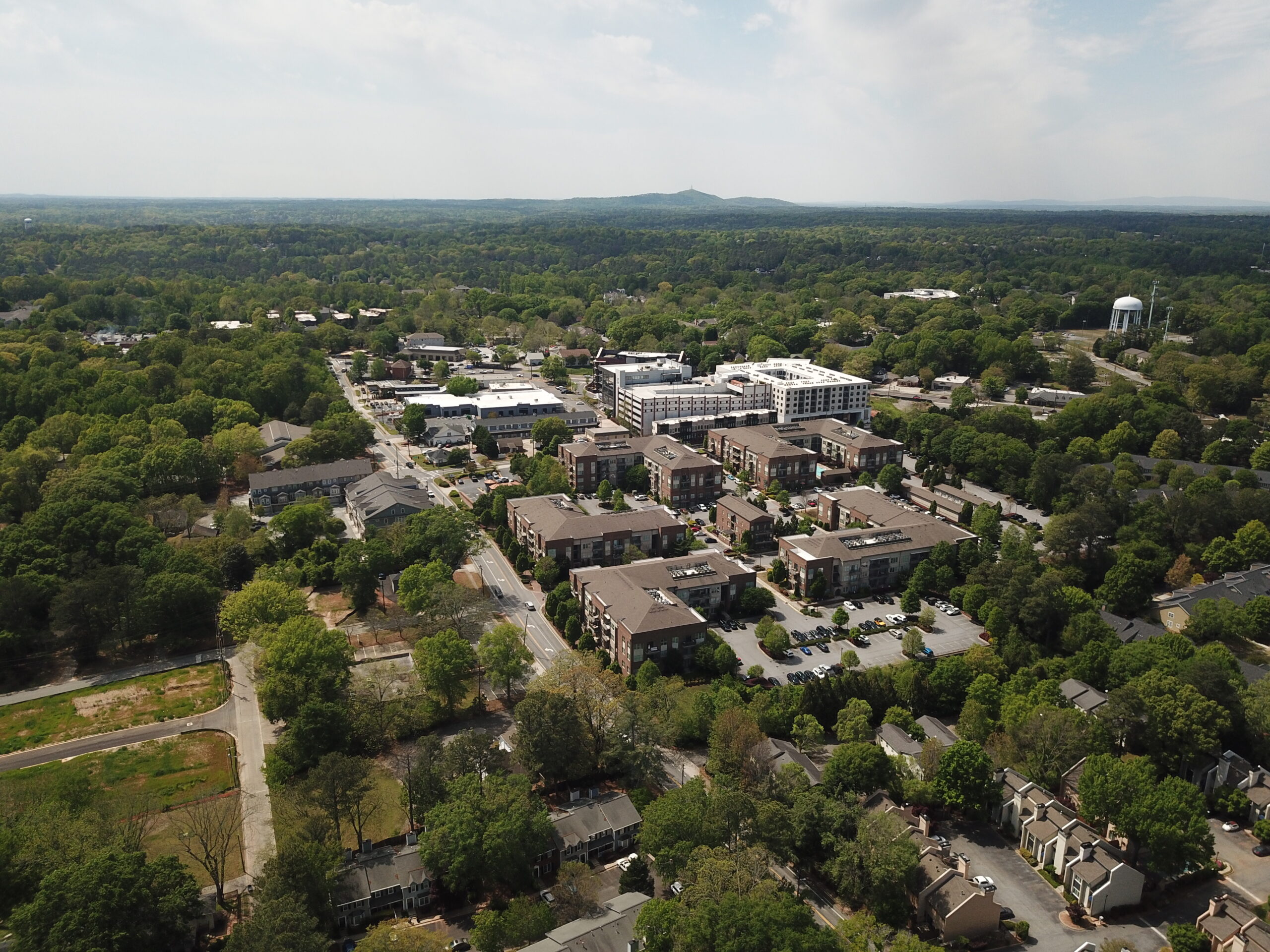
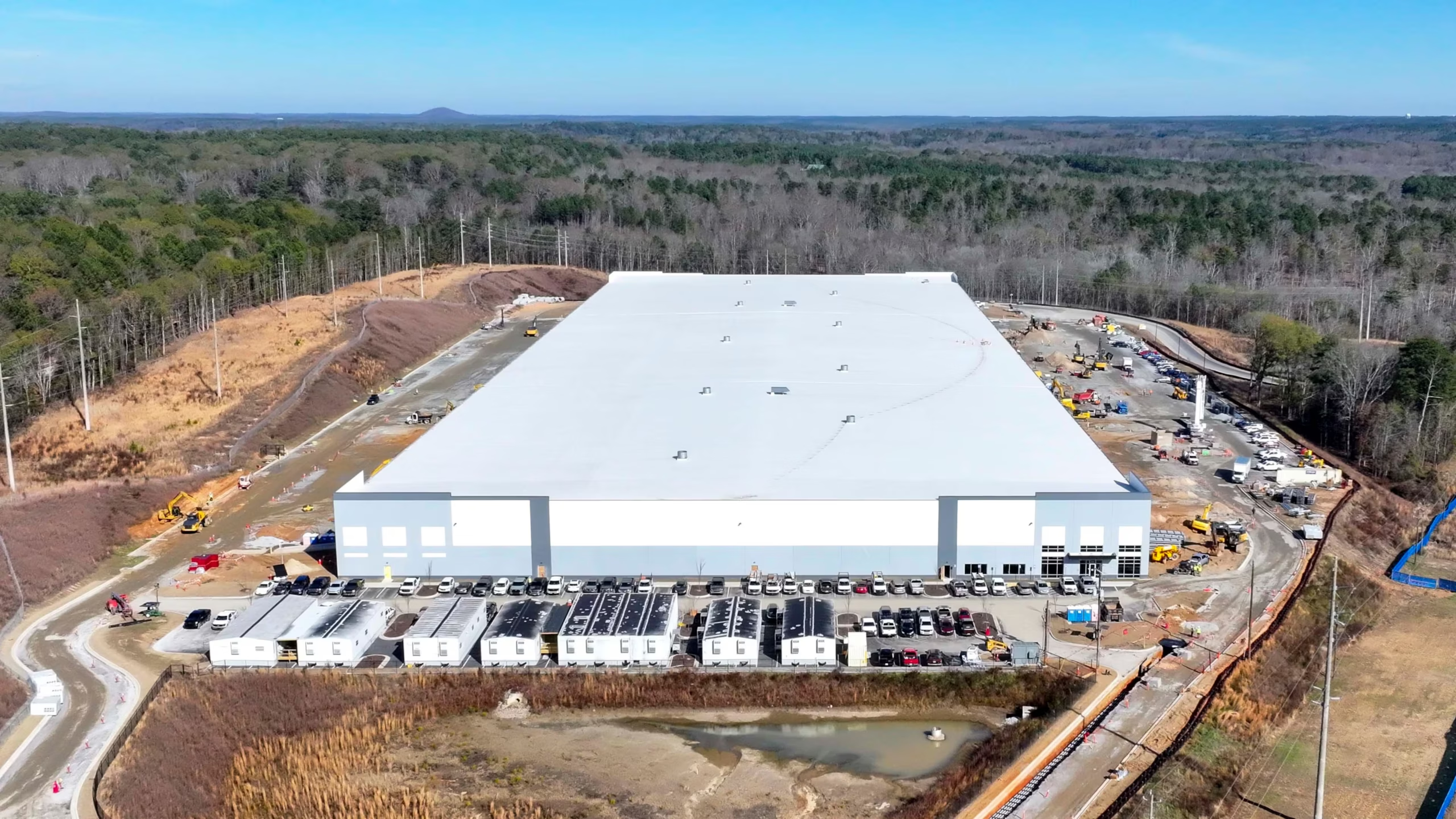

On the night of January 12, 2026, Roswell swore in a new mayor and three new council members. The rotunda at City Hall was full. People had come for the ceremony. The first substantive thing that council did after taking the oath was vote unanimously to stop data centers.
Six months later and twenty minutes south, the Marietta City Council chamber was standing room only, with the overflow crowd watching on a television in the lobby. Protestors chanted outside. Inside, the council voted 7-0 to table a rezoning request, then voted again to freeze all new data center applications through the end of the year. In August they approved the tabled project anyway, 5-2, because the application had been filed before the freeze took effect.
On August 18, Cherokee County commissioners held a public hearing on extending their own moratorium. Eleven residents signed up to speak. Not one spoke in favor. Several asked for a permanent ban.
Three rooms, three counties, one question underneath all of it: is this going to cost me my house’s value?
That question deserves a better answer than either side of the debate has been giving. This guide separates it into the three questions it actually contains, works through what the research shows, traces the five channels that connect a data center in Douglas County to a home in Johns Creek, and ends with four concrete scenarios showing how this could realistically show up in a sale price. If you are also weighing where to buy or what your baseline looks like, our cost of living comparison for Roswell, Alpharetta, Sandy Springs, and Marietta covers the underlying market numbers this article builds on.
Understanding the Metro Atlanta Data Center Boom
Atlanta went from a secondary market to the second-largest data center market in the United States in roughly three years. CBRE reported in March 2026 that metro Atlanta closed 2025 with 1,459.2 megawatts of total inventory, up 458.8 megawatts in a single year, trailing only Northern Virginia. The same report counted 2,076 megawatts under construction, a vacancy rate near 2 percent, and more than 3 gigawatts of long-term power commitments backing the pipeline. In 2024, metro Atlanta’s annual net absorption hit 705.8 megawatts and outpaced Northern Virginia for the first time.
To translate that: vacancy near 2 percent means space is leased before it is finished. Operators are not building on speculation and hoping tenants show up. They are building against signed commitments, which is why the pipeline has not slowed even as local opposition has hardened. This is not a bubble that a few moratoriums will pop.
Why Georgia, and why now. Three forces converged. Northern Virginia hit transmission constraints and power caps, pushing hyperscale demand to look elsewhere. Georgia had utility headroom, cheap land relative to the coasts, and a dense fiber grid running through Atlanta. And since 2018 the state has waived sales tax on servers, generators, cooling equipment, and related hardware for facilities meeting an investment threshold, a break worth close to half a billion dollars to date.
Where the campuses actually are. This is the part most of the debate skips, and it is the single most important fact for a north metro homeowner. The build-out concentrates where large parcels, high-voltage transmission, and fiber overlap. In Georgia that means Douglas, Coweta, Newton, Butts, Bartow, Fayette, and Spalding counties, plus south Fulton around Palmetto and Union City.
Look at the scale of what is being proposed out there. In Douglas County, a developer has sought approval for a five-building complex on more than 700 acres south of the I-20 Liberty Road exit, roughly the footprint of 532 football fields. A separate Douglas County application covers 164.7 acres and asks to convert land from residential low density to light industrial. In Spalding County in January 2026, commissioners unanimously approved zoning for a campus of up to ten buildings totaling nearly five million square feet on 190 acres, a project valued near $3.9 billion. Amazon Web Services is investing more than $11 billion across Butts and Douglas counties. Microsoft is building in Palmetto and planning a campus in Union City.
Now look at north metro Atlanta. There is no 700-acre assemblage available in Roswell. There is no 190-acre industrial parcel in Johns Creek. Land in the power-rich corridors developers actually want has already been bid past $1 million per acre, and north Fulton’s remaining large parcels are worth more as housing than as server halls. The largest data center actually approved anywhere in the six cities covered in this article is an 18-megawatt conversion of part of an existing storage building in Marietta. For scale, that is roughly one percent of what metro Atlanta already had online at the end of 2025.
The regulatory wave. Communities noticed before the economics did. By mid-2026, 34 Georgia counties and 23 cities had adopted, proposed, or were actively developing data center ordinances or moratoriums. Fayetteville went furthest, prohibiting new data centers in every zoning district as of March 5, 2026, and a 300,000-square-foot project there was formally withdrawn by its developers on March 18. Atlanta banned data centers inside the Beltline overlay in September 2024. Coweta County residents filed suit on May 5, 2026 seeking to overturn one approval outright.
That is the backdrop. Now the actual question.
North Metro Atlanta at a Glance: Market Position vs. Data Center Exposure
All housing figures are Zillow Home Value Index and related market metrics as of July 31, 2026, with median sale price reflecting June 2026. Using a single source and a single date is the only way this comparison stays internally honest.
| City | Typical home value | 1-yr change | Median sale price | Days to pending | For-sale inventory | Local data center status |
|---|---|---|---|---|---|---|
| Alpharetta | $722,997 | -0.4% | $733,000 | 32 | 491 | No campus; Fulton County opposes local incentives |
| Johns Creek | $704,500 | +0.5% | $732,667 | 29 | 366 | No campus; Fulton County opposes local incentives |
| Sandy Springs | $699,826 | +3.3% | $700,333 | 32 | 608 | No campus; Fulton County opposes local incentives |
| Roswell | $662,376 | +1.1% | $667,367 | 28 | 500 | Moratorium since Jan 2026, extended; UDC rules in drafting |
| Canton | $517,963 | -0.1% | $509,033 | 43 | 679 | Cherokee County moratorium; no ordinance yet |
| Marietta | $477,989 | -1.4% | $486,125 | 30 | 1,512 | Two approved projects; citywide moratorium to Dec 31, 2026 |
Read that table twice, because it quietly demolishes the loudest version of the argument.
Marietta has more approved data center activity than the other five cities combined. It also has the lowest typical home value in the group and the weakest one-year change at negative 1.4 percent. That looks damning until you notice Alpharetta, which has no campus, no approval, and no pending application, sitting at negative 0.4 percent. And Sandy Springs, equally campus-free, leading the entire group at positive 3.3 percent.
Marietta’s values trail Roswell’s by roughly $181,000 at the median sale, and they trailed before anyone filed a rezoning application on Powers Ferry Place. Marietta is a larger, older, more economically mixed city with 1,512 active listings against Johns Creek’s 366. That inventory ratio is the story. Days to pending across all six cities cluster between 28 and 32, except Canton at 43, and Canton’s softness comes from new construction supply in Cherokee County rather than from anything to do with servers.
Whatever is moving these six numbers, it is not proximity to a data center, because five of the six cities have no data center to be proximate to.
The Three Questions Hiding Inside One Question
When someone at a council meeting asks whether data centers will hurt property values, they are usually asking one of three completely different questions without realizing it. Sorting them is most of the work.
The fence-line question. Will the specific house that shares a property line with a facility sell for less? This is a real question with limited and contested evidence, and it applies to a very small number of homes.
The jurisdiction question. Will homes across a city or county be worth more or less because a campus landed inside the tax digest? This is mostly a tax and services question, and the answer depends almost entirely on what the governing body does with the millage rate afterward.
The regional question. Will homes across metro Atlanta be worth more or less because Georgia became a data center hub? This is an electricity cost and affordability question, and it applies to every household in Georgia Power territory whether or not a campus is anywhere nearby.
For Roswell, Alpharetta, Johns Creek, and Sandy Springs, the fence-line question is currently hypothetical and the jurisdiction question is a negative, because there is no campus to add to the digest. The regional question is the live one. Almost the entire public debate in those cities is being conducted as though the fence-line question were the one on the table, which is why the arguments generate heat and no resolution.
What the Research Actually Shows About Proximity
There are now three serious attempts to measure the fence-line and jurisdiction questions with data instead of anecdote, and they point in a consistent and counterintuitive direction.
Northern Virginia, the world’s densest data center market. The Center for Regional Analysis at George Mason University’s Schar School, led by director Terry Clower with Keith Waters, analyzed 2023 home sales across Northern Virginia against each property’s distance from a data center. This was not a simple price comparison. The researchers ran 13 separate factors known to move home prices, including proximity to industrial land, proximity to a Metro station, and new versus existing construction, and predicted the direction each would push. Eleven of the thirteen predictions held.
The exception was the one everybody cared about. The analysis failed to demonstrate statistical evidence that proximity to a data center negatively affects housing values. Holding everything else equal, the closer a home sat to a data center, the higher its value. The relationship held across single-family homes, townhomes, and condos.
Waters told the university afterward that he had not been particularly surprised, and his explanation is the important part. Data centers get built where infrastructure is strongest, meaning good roads, reliable utilities, dense fiber, and proximity to employment and airports. Those are the same features that make neighborhoods attractive to buyers. Nobody is paying extra for a view of a server hall. They are paying for the interstate access and the transmission capacity that attracted the server hall in the first place. Causation runs through the infrastructure, in both directions, which is exactly what makes this hard to measure.
The peer-reviewed replication. A 2026 working paper by Alex Priest took a different approach, matching air permit issuances for Virginia data centers to ZIP-code-level home price indices in a difference-in-differences framework. That design tries to isolate causation by comparing what happened to prices in permitted areas against comparable unpermitted areas over the same window. Across multiple specifications and event-study designs, the estimated effects were economically small and slightly positive. The confidence intervals ruled out substantial price declines. The results held for recent permits tied specifically to AI facilities, which is the category driving the current Georgia boom.
Indiana, four counties, and the detail that got buried. A study covering 2021 through 2026 examined 80 homes near data centers in St. Joseph, LaPorte, Clark, and Allen counties. The headline: combined, homes within 1.5 miles appreciated 42 percent against 41 percent for their local markets. Essentially a wash, slightly favorable.
The detail underneath is more useful, and it is the kind of thing that gets left out of the slide deck at a rezoning hearing. Homes near data centers gained less than the local market average in three of the four sites. One site outperformed strongly enough to drag the combined average above the local benchmark. And the study window included years before any data center was announced, meaning pre-announcement appreciation is doing real work inside that 42 percent figure.
What the researchers themselves say the limits are. Clower has been explicit that the finding does not mean a data center is a positive for value, only that it does not create a drag. The GMU authors also noted their results may be more applicable in areas with constrained housing demand, which is a polite way of saying Northern Virginia is a market where nearly everything appreciates and a modest drag could be invisible under the tide. One critic made the affordability point bluntly: in a national housing shortage, plenty of people will buy next to almost anything if it is the house they can actually get.
The Loudoun County asterisk. There is a specific reason Northern Virginia home values behave well near data centers, and it does not travel. Residential property tax rates in Loudoun County have fallen 38 percent since 2010 because the data center tax base absorbed so much of the burden. Lower carrying costs raise what buyers can pay, which raises home prices. That is a tax digest effect, not a proximity effect, and it requires roughly the density of facilities that earned Loudoun the nickname Data Center Alley. A county with two campuses does not get a 38 percent residential rate cut. It might get one percent, and it might get zero, for reasons covered below.
And the Prince William counterexample. Not every Virginia homeowner came out ahead. In Prince William County, landowners whose property was rezoned for the Digital Gateway project saw assessments jump on the strength of the rezoning alone, producing tax bill increases in the neighborhood of $35,000. Then litigation stalled the project. Those owners were left holding land assessed at data center value, taxed at data center value, with no closing in sight and no way to force one.
That is a narrow scenario, but it illustrates something that applies broadly: the announcement itself changes assessed value before a single foundation is poured. Assessment moves faster than a sale does. If you own acreage anywhere near a rumored assemblage in Cherokee or Cobb, that is the risk to understand, and it is the opposite of the risk everyone shows up to the hearing worried about.
Where the averages break down. Every one of these studies measures effects across distance bands, typically 1.5 miles. A data center’s noise, exterior lighting, and generator testing do not distribute evenly across a mile and a half. They concentrate at the property line and fall off fast. One Northern Virginia paired case reported by a data center policy tracker described a four-bedroom home roughly 200 feet from a hyperscale campus listing at $580,000 against comparable homes with no adjacency at $685,000 to $710,000, a spread of 15 to 18 percent. That is one anecdote, not a study, and the source has an editorial position. Plaintiff-side appraisers in nuisance litigation typically frame diminution at 5 to 20 percent of pre-construction value for directly adjacent parcels, which is also an advocacy number produced by people paid to argue for the high end.
Put honestly: there is no credible evidence of a systemic, ZIP-code-wide hit to home values from data centers, and there is limited, contested, advocacy-tinged evidence of a meaningful discount for homes directly on the fence. Both of those can be true at once. Most public arguments pick one and pretend the other does not exist.
Channel One: Your Power Bill, and Why It Reaches Roswell Anyway
This is the channel that touches every household in all six cities, and it has nothing to do with where anything gets built.
In December 2025 the Georgia Public Service Commission certified 9,885 megawatts of new generation capacity, roughly the output of five Hoover Dams. Estimated construction cost is $16.5 billion. Total ratepayer cost over the life of those assets has been estimated at $50 to $60 billion. According to the report prepared for state auditors, about 80 percent of that output is slated for current and future data centers.
The certification was contested inside the Commission’s own process, which is worth knowing. PSC staff testimony in November 2025 recommended certifying only 30 to 40 percent of what Georgia Power requested, warning that much of the projected demand rested on speculative forecasts rather than executed contracts. An independent Monte Carlo analysis found that Southeastern utility demand projections of that magnitude materialized in roughly one out of 500 simulations. The Commission certified nearly the full request anyway.
The guardrails that exist. The Commission ordered a freeze on Georgia Power base rates through 2028. Georgia Power carries a financial backstop through 2031 if contracts for the projected load do not materialize, and the Commission retains remediation authority for five years beyond that. In April 2026 the Commission approved a Customer Identified Resource program letting large customers propose and fund their own clean generation in exchange for bill credits, up to 3 gigawatts through 2035. Large load tariffs nationally, Georgia’s included, increasingly carry take-or-pay minimum billing provisions that fix a customer’s monthly charge at a high percentage of contracted capacity regardless of actual usage, which is designed to protect against exactly the stranded-asset scenario the staff warned about.
The guardrails still being argued about. In May 2026 the Commission opened a separate investigation into whether large industrial customers, data centers included, are shifting fuel costs onto households and small businesses. That is a distinct question from base rates, and base rates are the thing that is frozen. Fuel and storm costs were adding roughly $6 a month to residential bills, offset for now by a legacy charge from the 2022 gas price spike rolling off, producing a small net decrease. At the state level, Senator Chuck Hufstetler has pushed legislation to keep data center generation, transmission, and fuel costs out of general rates permanently, arguing the Commission’s own rule lacks the permanence of law and could be undone by a future Commission. A separate bill would require large facilities to publicly report annual energy and water usage. None had become law as of this writing.
What this actually does to a house price. Here is where the mechanism gets concrete, so here is the arithmetic. All of it is illustrative, built on cited inputs, and none of it is a forecast.
A buyer qualifies on total monthly housing cost, and utilities factor into affordability. At the roughly 6.4 percent 30-year fixed rate prevailing in spring 2026, every dollar of monthly payment supports about $160 of loan principal. So:
- A $10 per month permanent increase in the average residential power bill removes roughly $1,600 of borrowing capacity.
- A $20 per month increase removes roughly $3,200.
- A $35 per month increase removes roughly $5,600.
Against a typical Roswell home value of $662,376, even the $35 figure is about eight tenths of one percent. It is real, it is permanent, and it is small. It does not show up as a data center penalty on any one house. It shows up as slightly less purchasing power across every buyer in the metro simultaneously, which is the most boring and most durable way an effect like this actually travels. You will never see it on an appraisal. You will see it in what the marginal buyer can stretch to.
The honest framing for a north Fulton homeowner is not that data centers will crater your value. It is that you are being asked to help fund generation capacity that will be consumed in Douglas and Newton counties and monetized in their tax digests, and you get the bill without the offset. That is a fiscal fairness argument. It is a legitimate one, and it is the strongest thing residents can say at a Commission hearing. It is just not a property value argument, and conflating the two is why these meetings go badly.
Channel Two: The Tax Digest, and the Lesson From Douglasville
This is the channel where data centers do the most measurable good, and where that good most often fails to reach homeowners. What happened in Douglasville this summer shows exactly how the failure works.
How big the digest effect is. The University of Georgia’s Carl Vinson Institute of Government studied four metro Atlanta data centers for the state’s tax incentive evaluation. The land under each complex averaged $26 million. The servers and electrical equipment inside added roughly $1.8 billion to the average property’s assessed worth. The buildings housing them added at least $450 million more. That is not a rounding error on a county digest. That is a new economic geography.
For a representative three-building campus valued above $2 billion including land, buildings, and equipment, the annual property tax bill at average Georgia millage rates would run about $33.6 million. Typical bonds-for-title abatements shave off roughly $5.9 million, under 20 percent of the liability. That leaves about $27.8 million owed every year, which makes the facility one of the largest single taxpayers in its jurisdiction on the day it energizes.
To put $27.8 million in terms a Roswell homeowner can feel: Georgia assesses property at 40 percent of fair market value, and the state’s average combined county and municipal millage is about 30 mills. On that basis, a Roswell home at the typical $662,376 value generates roughly $7,950 a year in county and city property tax before homestead exemptions. One data center campus paying $27.8 million produces the equivalent of about 3,500 such homes. A single campus can carry the tax load of an entire large subdivision, and it will never enroll a child in school, call for an ambulance, or add a car to the morning backup on Holcomb Bridge Road.
That is the strongest argument the industry has, and it is a good one. Georgia data centers also generated 28,350 construction-related jobs in 2025 worth $3.4 billion in economic activity, plus 5,471 permanent operations jobs worth another $823 million. PSC Commissioner Tricia Pridemore pointed at this directly when defending the generation expansion, noting that south metro counties are planning new school construction on data center revenue.
Now the part that determines whether homeowners see any of it. Georgia law requires that when a tax digest grows through reassessment, the taxing authority calculate a rollback millage rate, meaning the rate that would generate the same revenue as the prior year absent the reassessment. If the governing body keeps the old rate instead of rolling back, that is legally a tax increase and triggers three mandatory public hearings.
In July 2026, Douglasville held those hearings. The city proposed to keep its millage at 8.749 mills against a rollback rate of 8.159 mills, which the city calculated as a 7.23 percent higher levy for property owners. City Manager Marcia Frazier explained the mechanics plainly: the digest’s growth over the prior year came mainly from commercial properties and business personal property, not from a uniform rise in home values.
Read that again, because it is the whole lesson. Business personal property is the servers and the switchgear. The commercial digest grew. The residential digest did not grow proportionally. And the city’s proposal was to keep the rate flat and collect the additional revenue rather than roll it back to homeowners. Douglas County’s Board of Commissioners was in the same posture the same month, calculating that holding its current millage would increase the annual bill on a $350,000 home by roughly $64, or about $61 with a homestead exemption.
The Loudoun County outcome, where residential rates fell 38 percent over fifteen years, is not what happens automatically when a data center arrives. It is what happens when a governing body decides, year after year, to roll the rate back and hand the benefit to homeowners. Loudoun made that choice repeatedly. Douglasville, in July 2026, faced a much smaller version of the same choice and proposed not to.
If you want to know whether data centers will help your property tax bill, the ordinance is not the document to read. The July millage rate hearing notice is.
Why this matters in Roswell specifically. Roswell will not receive a $27.8 million campus taxpayer under any realistic scenario. What Fulton County did instead was try to ensure nobody else in the county gets one on discounted terms. On August 5, 2026 the Board of Commissioners approved a resolution opposing tax abatements or other financial incentives for data center projects from any development authority in the county, and urging the Development Authority of Fulton County to decline consideration of them.
The resolution is unusually candid about its own reasoning. It states that hyperscale operators are among the most well-capitalized entities in the world and have publicly indicated that local tax incentives are not determinative in their siting decisions, so additional locally funded incentives are not necessary to attract the investment. Translated: if they are coming anyway, stop paying them to come.
Zoning authority still rests with Fulton’s 15 cities, so the resolution shapes what a project costs the public, not whether it gets approved. It is a floor, not a wall.
Channel Three: Land Competition and the Opportunity Cost
Between 2023 and 2024, metro Atlanta data center inventory expanded at an estimated 43 percent annually. Over the same window, multifamily and adjacent residential product grew at generally under 3 percent. Land is finite, and one of those two uses is outbidding the other by a wide margin.
Data centers are extraordinarily land-hungry and extraordinarily job-light relative to their footprint. That statewide figure of 5,471 permanent operations jobs, spread across 63 active facilities, works out to fewer than 90 permanent positions per facility. In Douglas County, a developer told residents its 700-acre proposal would generate 200 to 300 permanent jobs, which is well above that average and still fewer people than a single mid-sized employer occupying a fraction of the acreage. The construction jobs are real and substantial. Construction jobs also end.
What this does to value, in both directions. Where land competition is fierce, it supports existing home prices by tightening supply. That is the direction it cuts in north Fulton, where large parcels are already scarce and expensive. Every acre that does not become new housing supports the value of housing that already exists. If you own in Roswell or Johns Creek and you are looking purely at your own resale number, regional land absorption is mildly in your favor.
It also worsens affordability, which is why local governments across the political spectrum converged on the same posture within a single year. Officials have increasingly questioned whether large tracts should be absorbed by low-employment industrial uses at a moment when housing supply is politically radioactive. Those two effects, supporting your resale and worsening your children’s ability to buy nearby, are the same effect described from two directions.
The clearest statement of the tradeoff came from a resident, not a consultant. Derek Wood was the only member of the public to speak on the moratorium at Roswell’s January 12 council meeting. His framing was sharper than most of the professional commentary: Roswell could absolutely make significant tax revenue from data centers, and the real question is whether that land would serve Roswell residents better thirty years from now under a different use. He argued that public policy should be looking a decade or three ahead rather than at revenue cycles a quarter or two out.
That is the actual property value question in a place like Roswell, and it operates on a much longer clock than any sale price this year. A parcel converted to industrial use is functionally converted forever.
Channel Four: Water, the Chattahoochee, and the Slow Variable
Metro Atlanta has a water problem that most data center markets do not. The region sits at the headwaters of six small river systems rather than downstream of a large one, which is why the Metropolitan North Georgia Water Planning District treats large new industrial draws differently than most parts of the country would. Georgia has been litigating water allocation with Alabama and Florida for three decades, and the region does not have slack to give away.
A large evaporative-cooled campus can draw one to five million gallons per day at peak, enough to visibly strain a small county system. Newer Georgia campuses are moving toward closed-loop and air-cooled designs that cut water draw by 70 to 90 percent, but that is not free. Air cooling pushes more of the thermal load back onto electricity, which pushes back onto the grid, which pushes back onto Channel One. There is no configuration that makes both problems disappear, and contractors bidding mechanical scope on these projects report that cooling design frequently shifts mid-project as operators react to local pushback.
This is not abstract for north Fulton. When Roswell’s council adopted its moratorium, it named the Chattahoochee River explicitly among the resources it wanted time to consider, along with utility capacity and the power grid. Mayor Mary Robichaux framed the pause around what resources these facilities actually require, and said plainly that the city was not ruling out ever permitting one.
Marietta wrote the water question directly into its approval conditions. When the council approved the Powers Ferry Place project 5-2, the conditions required that the developer not use the city’s municipal water or wastewater systems at all. The applicant’s representative made the same point in the hearing, describing the facility as a closed-loop system that would not draw on Cobb or Marietta water.
That is a template worth noticing. Water impact is the one category where a well-drafted condition can substantially eliminate the harm, and where a vague ordinance leaves a community with no recourse after the fact. Elsewhere in Georgia, controversies over data center water consumption have turned on exactly this gap: whether usage is metered, whether it is publicly reported, and whether the community can verify what it was told. One reason a state bill would ban local governments from signing nondisclosure agreements covering data center water and electricity usage is that some communities discovered they had no legal way to find out.
For riverfront and near-river property in Roswell and Sandy Springs, water policy is a slower and more consequential value variable than any single facility approval will ever be.
Channel Five: Noise, and Why It Only Reaches the Fence Line
Noise is the complaint that surfaces first at every hearing and the one hardest to argue about productively, because the character of the sound matters more than the decibel number.
Data center noise is not like highway noise. Highway noise rises and falls. Cooling and generator noise is constant and tonal, concentrating acoustic energy at a specific low frequency. Low-frequency sound penetrates walls and windows more effectively than higher-frequency sound, which is why residents near facilities report that closing the windows does not solve it and why some describe a vibration sensation rather than a sound. Reported effects include sleep disruption from overnight operation and reluctance to use outdoor space.
At a Douglas County planning and zoning hearing on one proposed campus, the board chairman made an observation that had nothing to do with operations at all: neighbors would be living with construction noise for six or seven years before the facility was even finished. Construction impact on a multi-building campus is not a phase to wait out. It is most of a decade, and it is the part of the timeline that almost never appears in a disclosure conversation.
How this reaches a sale price. Noise is the mechanism most likely to produce a genuine fence-line discount, and it is also the one most responsive to conditions of approval. Marietta’s 5-2 approval carried a specific list: install silencers, conduct independent noise testing rather than accepting self-reporting, and stay off municipal water and wastewater. Independent testing is the load-bearing word in that list. A decibel limit nobody verifies is a press release.
Site context does enormous work here too. One observer of the Marietta approval noted that the Powers Ferry site sits directly against I-75, where ambient highway noise is already constant, meaning a resident might never distinguish a backup generator test from traffic. A facility against an interstate in an already-commercial corridor is a fundamentally different proposition from the same facility backing onto a quiet residential cul-de-sac. When residents at that hearing said the rezoning had not been advertised early enough for them to organize, they were fighting for the chance to argue precisely that distinction before the vote rather than after it.
For a seller, the practical question is narrow and answerable: can a buyer standing in your backyard hear it? If yes, expect it to surface in negotiation and expect to price for it. If no, the research says it is not appearing in your comparables.
City by City: Where Each North Metro Market Actually Stands
Roswell. The moratorium adopted January 12, 2026 ran 90 days to April 12. On March 23 the Mayor and Council approved a 95-day extension to June 26 to give staff time to consolidate research. Staff produced a 27-page white paper, which the Planning Commission heard on May 19 along with a proposed regulatory framework to restrict operations within the city. A public hearing on June 4 drew resident testimony and the item was deferred to June 16. Staff has continued requesting extensions while the ordinance is drafted. Roswell had no data-center-specific provisions in its Unified Development Code when the moratorium passed, which is precisely why the pause was needed and precisely what the ordinance is meant to fix. Existing facilities may continue operating and legally vested development rights are unaffected. Neighboring Milton adopted its own moratorium.
Marietta. The most instructive case in north metro, because it is the only one where the full cycle has played out from proposal to approval. On July 8, 2026 the council unanimously adopted a six-month moratorium running through December 31, then tabled the Powers Ferry Place rezoning to August. In August it approved that rezoning 5-2, allowing an 18-megawatt data infrastructure facility at 1155 Powers Ferry Place off Delk Road next to I-75, converting roughly 22 percent of an existing 90,000-square-foot storage building. The applicant framed it as mission-critical local capacity serving law enforcement, medical and emergency services, and area businesses, rather than a hyperscale campus.
The moratorium did not apply because the application predated it, which is how moratoriums work everywhere and which caught residents off guard. A separate project on Bells Ferry Road near I-75 had already been approved earlier in the summer, and neighbors there said publicly they had not learned about the hearings early enough to respond. The Planning Commission had advanced the Powers Ferry rezoning on a 4-3 vote before it reached council. The approval carried the conditions described above.
Cobb County, unincorporated. The Board of Commissioners adopted a moratorium in February 2026 and extended it another 180 days, now expiring February 24, 2027. Cobb’s zoning code dates to 1972 and contains no data center provisions at all, which is the same structural gap Roswell and Cherokee identified. The draft Unified Development Code would add data centers as a new use permitted only in light and heavy industrial districts, and only with a special land use permit approved by the Board of Commissioners, alongside standards addressing impacts on surrounding properties, infrastructure, power, and water. Members of the Cobb legislative delegation have also introduced state-level bills, including one suspending new sales and use tax exemptions for a year and prohibiting nondisclosure agreements on data center water and electricity usage.
Cherokee County and Canton. Commissioners adopted a 30-day moratorium on July 21, 2026, stating from the outset they intended to extend it. On August 18, after the public hearing where eleven residents spoke and none spoke in favor, they extended it by 180 days, running to roughly mid-February 2027. Community Development Director Brantley Day was direct about the reasoning: data centers have been proposed and built in neighboring counties and across the state in recent years, Cherokee has no ordinance specifically addressing the use, and staff needed time to work with the legal department to develop one. That work is folded into ReCode Cherokee, the county’s full rewrite of its 1992 zoning ordinance and 1998 development regulations into a new Unified Development Code. Canton’s 43 days to pending and 679 active listings, the softest absorption in the group, reflect new construction supply rather than anything to do with this debate.
Alpharetta, Johns Creek, and Sandy Springs. No campus, no approved project, no pending application, and no fence-line exposure as of this writing. Fulton County’s August resolution against local incentives covers them, but zoning authority remains with each city, and none has adopted a moratorium of its own. Their exposure is entirely Channel One and Channel Three: the power bill, and the absence of any tax digest offset to go with it. If you live in one of these three cities and you want to affect this issue, the Public Service Commission docket is a better use of an evening than a city council meeting.
Four Scenarios: How This Could Realistically Show Up in a Sale Price
These are illustrative scenarios, not predictions. Each is built from figures cited above, and the arithmetic is shown so you can substitute your own numbers.
Scenario A: The Roswell homeowner with no campus within twenty miles. You own at the Roswell typical value of $662,376. There is no data center in Roswell and the nearest hyperscale campus is in another county. Your exposure is a regional electricity effect and nothing else. If residential bills rose a permanent $20 per month, metro-wide buyer purchasing power falls by roughly $3,200, about half of one percent of your value. That is smaller than the swing you would get from fresh paint and staging. Meanwhile your competition is 500 active listings and your market is going pending in 28 days. Nothing about data centers belongs in your pricing conversation. Price against your comps and your condition, and spend the worry budget on the PSC docket instead.
Scenario B: The Marietta homeowner 600 feet from Powers Ferry Place. You own near the approved 18-megawatt conversion at a typical value of $477,989. The aggregate studies say homes within 1.5 miles show no measurable drag, and you are well inside that band, so the ZIP-code evidence is on your side. But you are close enough that a buyer in your backyard may hear equipment, and the fence-line evidence is thinner and less favorable. If the plaintiff-side 5 percent floor applied, that is roughly $23,900. At the disputed 15 to 18 percent adjacency figure, it would be $71,700 to $86,000.
Three things push you toward the low end or to zero. The site sits directly against I-75 where ambient noise is already constant. The approval requires silencers and independent noise testing rather than self-reporting. And the facility is barred from municipal water and wastewater. Your practical move is to obtain the recorded conditions of approval and the independent noise test results once they exist, and hand them to your agent as a disclosure package. A buyer’s imagination will always price this worse than a document will.
Scenario C: The Canton homeowner if Cherokee approves a campus after February 2027. Your typical value is $517,963 and your market is already the softest in the group at 43 days to pending with 679 listings. If Cherokee’s new ordinance permits a facility and one lands in the county but not adjacent to you, the fence-line question does not apply to you at all. The jurisdiction question does, and it cuts your way only if the Board of Commissioners rolls back the millage when the digest grows.
Using the state’s method at 40 percent assessment and 30 mills, your current county and city tax runs roughly $6,200 a year. A single large campus paying $27.8 million into a county digest is meaningful relief if it is passed through and worth exactly nothing to you if it is not. Douglasville in July 2026 shows how that decision tends to go when it actually comes up. Watch the rollback hearings, not the ribbon cutting.
Scenario D: The Alpharetta or Johns Creek seller in 2029. Your value today is $722,997 or $704,500. The Georgia Power base rate freeze expires in 2028, after which the Commission has full latitude to reset rates. If the projected data center load materializes as contracted, the certified generation gets paid for largely by the customers who use it and the effect on you is modest. If it does not, Georgia Power’s backstop runs through 2031 and the Commission retains remediation authority beyond that, but PSC staff’s own November 2025 testimony flagged the forecasts as speculative and an independent analysis put the odds of demand at that scale materializing at roughly one in 500.
Your risk here is not that a data center appears next door. It is that you help pay for generation nobody ended up needing, permanently, through a monthly bill, while Newton and Douglas counties hold the tax digest that would have offset it. That is genuinely worth watching. It is not worth pricing into a 2026 listing.
What This Means If You Own, Buy, or Sell Here
Do not price a data center into your Zestimate. In Roswell, Alpharetta, Johns Creek, and Sandy Springs there is currently nothing to price in. What is moving your value is visible in the table near the top of this article: 366 to 1,512 active listings depending on city, 28 to 43 days to pending, and one-year changes between negative 1.4 and positive 3.3 percent, in a market where the 30-year fixed sat near 6.4 percent.
Keep the long arc in view. The S&P Case-Shiller Atlanta index bottomed at 82.5 in March 2012, sat at 136.47 at the pre-crash peak in July 2007, reached 168.58 in December 2020, and stood near 249.8 in January 2026. Atlanta home values have roughly tripled from the trough, gained 83 percent past the 2007 peak, and added 48 percent since the end of 2020. Whatever an 18-megawatt storage conversion off Delk Road does to that curve, it is not visible at this resolution.
If you are buying within sight of a campus, change your diligence, not your panic. Get the recorded conditions of approval. Ask specifically about the decibel limit at the property line, whether testing is independent or self-reported, the generator testing schedule, buffer and screening requirements, exterior lighting specifications, whether the facility may draw municipal water, and the construction timeline. Douglas County’s planning chairman was blunt that neighbors would live with construction for six or seven years, and that phase gets skipped in almost every disclosure conversation. Marietta’s condition list is a usable model for what a well-conditioned approval looks like, and its absence is a usable warning.
If you own raw acreage near a rumored assemblage, understand the Prince William risk. Assessment can move on a rezoning before any sale closes, and a stalled project leaves you taxed at the new value with no buyer. That is a different risk than the one your neighbors are worried about, and it is the one more likely to actually cost you money.
Watch the ordinances, not the announcements. Every moratorium referenced here expires between December 2026 and February 2027. Roswell, Cobb, Marietta, and Cherokee are all writing permanent rules right now. The buffer distances, megawatt thresholds, noise caps, water restrictions, and disclosure requirements adopted in those ordinances will govern every application filed afterward, for decades. A moratorium binds nothing filed before it took effect, which Marietta residents learned in August. The ordinance is the durable thing, and it is where residents still have real leverage.
Watch the millage rate hearing. If you live in a county that hosts a campus, the single vote that determines whether you personally benefit is the rollback decision, held every July, usually to an empty room. Loudoun County’s 38 percent residential rate reduction and Douglasville’s 7.23 percent levy increase came from the same underlying mechanic and opposite choices.
Watch the Public Service Commission. The fuel cost allocation investigation opened in May 2026 and the 2028 expiration of the base rate freeze will do more to the monthly cost of owning a home in north Fulton than any zoning vote in Roswell. Pending state legislation on ratepayer protection, mandatory energy and water disclosure, and suspension of the sales tax exemption would change the arithmetic again. None of it had become law as of this writing.
The claim that data centers will crater metro Atlanta property values is not supported by the available evidence. The claim that they are free for homeowners who do not host them is not supported either. The accurate version is narrower and less satisfying than either side wants: north metro Atlanta is being asked to help fund the electricity for a build-out landing in other counties’ tax digests, and whether the counties that do host it pass any of the benefit to their own homeowners depends on a rollback vote that happens every July with almost nobody in the room.
Roswell Pulse tracks the local decisions that move real numbers, not the ones that just move headlines.